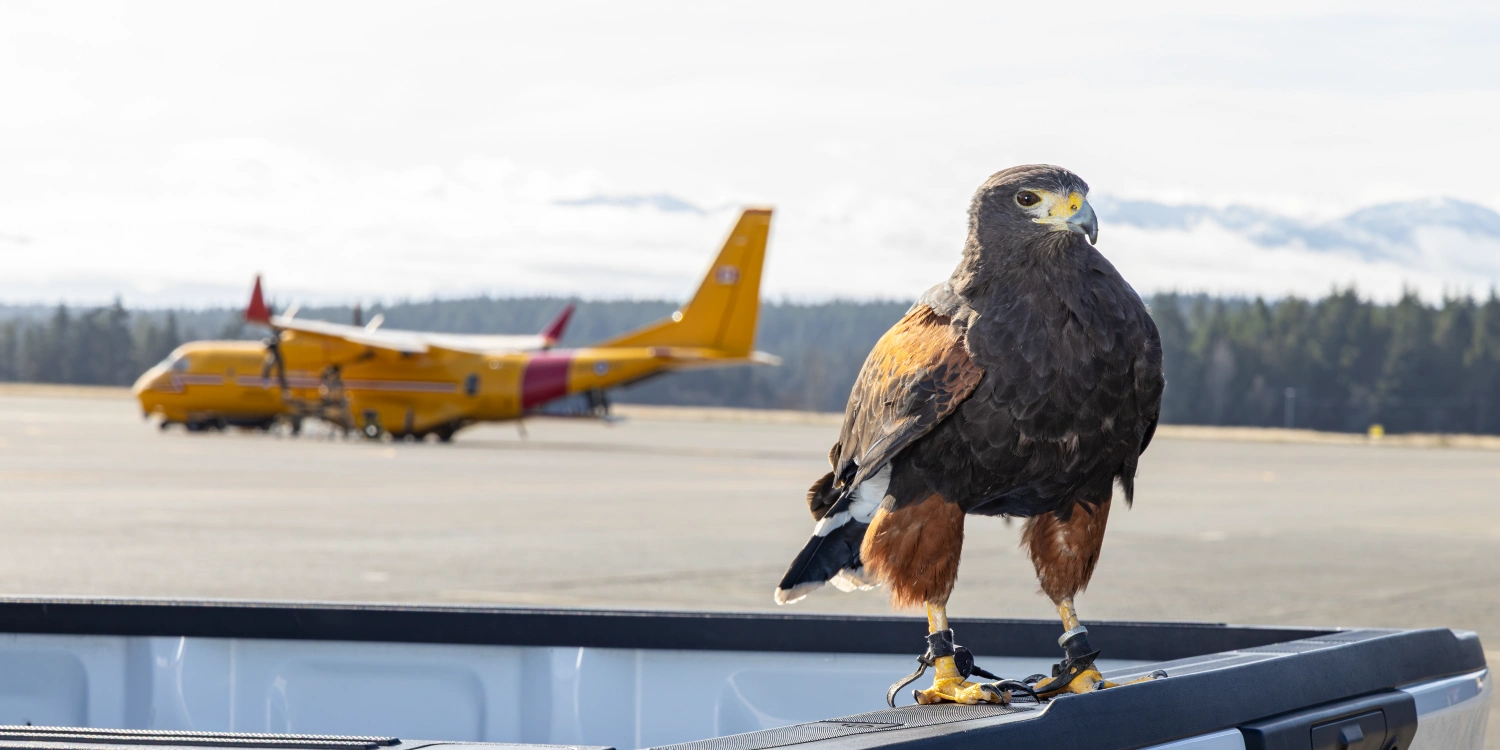
Wildlife management in coastal environments is a constant challenge—especially where aircrafts and birds share the same airspace. At the Comox Valley Airport, that responsibility falls partly to an unexpected guardian in the sky: Tuari, a 17-year-old Harris’s hawk weighing just over one kilogram.
Tuari patrols the airfield not as spectacle, but as strategy. Through her natural authority in the air, she creates a “landscape of fear,” encouraging other birds to relocate and linger elsewhere. Using falconry, trained raptors establish a persistent predator presence, reducing wildlife activity and lowering the risk of bird strikes during takeoff and landing.
Native to the deserts and open grasslands of the southwestern United States and Central America, Harris’s hawks might seem out of place on the coast of British Columbia. But Tuari thrives in the Pacific Northwest, thanks to her intelligence, social nature, and daily training alongside Comox Valley Airport’s wildlife management team. She understands her purpose: to deter high-risk species such as gulls, geese, and crows from the airfield.
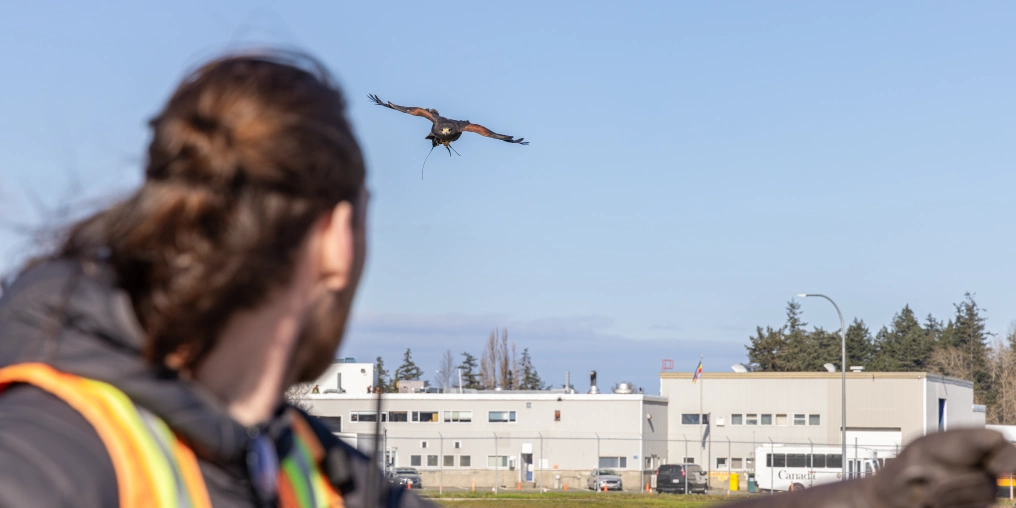
Training a hawk to clear the runway
The raptor program is part of a long-term strategy to change bird behaviour around the runway. The team’s role is to place Tuari in the most advantageous position, allowing her to launch into decisive flights that assert her presence and push other birds away from active operations.
“Her presence has helped me discover more about myself—how I show up, communicate, and adapt
For the wildlife management team, working with a Harris’s hawk is less about control and more about building trust over time. Zack Davis, one of the wildlife technicians at YQQ, describes the experience as both challenging and natural. “The Harris’s hawks’ ability to work socially is a great boon as we identify and clear wildlife hazards together, often relying on their vision to see things my human eyes would miss,” he says. “Every interaction with wild birds is a form of training, and being able to work with a raptor provides a lens directly into the natural world. It’s incredible, primal, and the strangest buddy cop movie you’ve ever seen.”
“Every day, I feel fortunate to work alongside Tuari on the airfield,” Kasey Baynton, another team member, says. “She is not only a remarkable bird and coworker but also an unexpected mentor. Her presence has helped me discover more about myself—how I show up, communicate, and adapt.”
Kasey adds, “Through working with Harris’s hawks, I’ve gained new insight and learned to see challenges on the airfield from elevated perspectives.”
As for myself, having worked with Tuari for just over a year, watching her fly—focused and completely in her element—is mesmerizing. Her energy sharpens my attention, drawing me into the moment, deeply focused on the task at hand. The bond we’ve built through patience and trust is what enables us to work together effectively.
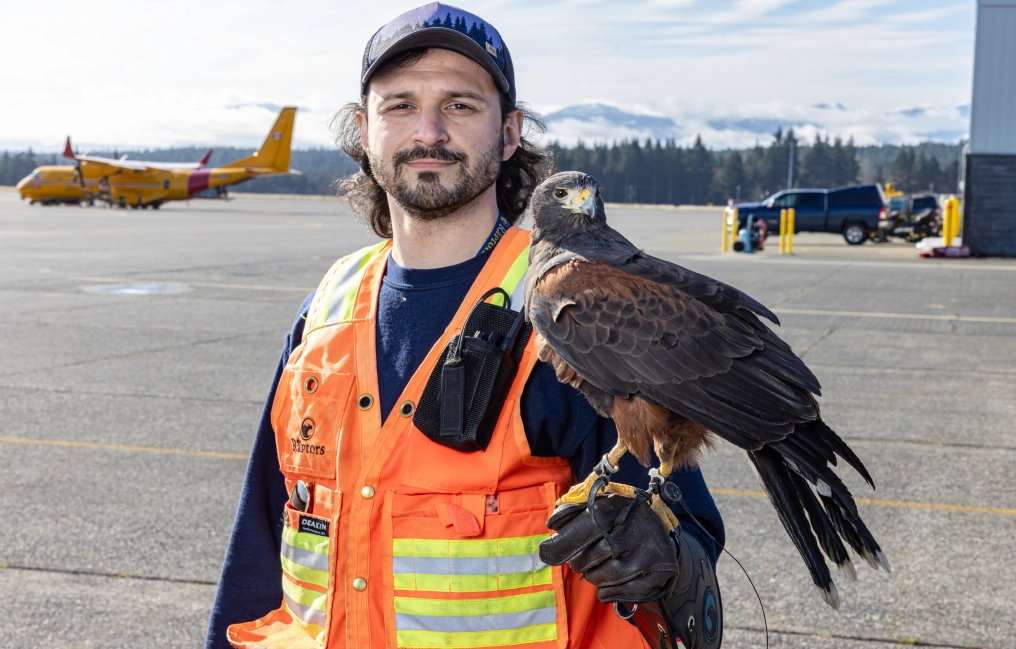
A second hawk joins the team
Tuari had already made a noticeable dent in high-risk bird activity at the airport when she was joined by a new recruit: Slightly, a male Harris’s hawk. Together, their presence helps manage local bird populations and contributes to a reduction in bird strike risk. Between patrol flights, the hawks are housed in aviaries on the airfield, ready to respond as part of the daily wildlife management routine.
A data-driven approach to wildlife risk
Sean Baynton, Comox Valley Airport’s Wildlife Management Coordinator, has more than a decade of experience managing wildlife hazards at airfields on the West Coast and across Canada. “The work of our team educates local wildlife that there are safer places to spend time than on the airfield,” he explains. “Our program is data-driven, analyzing seasonal trends and the conditions that influence wildlife behaviour in order to predict and manage risk before it affects operations.”
“We are proud to make the Comox Valley a safer place for aviators and travellers”
Supported by the Pacific Northwest Raptors Centre in Duncan, where both hawks were born and first trained, Tuari and Slightly’s presence in Comox is part of a broader effort across Vancouver Island and Canada; using trained hawks in this way is now industry best practice.
As the team’s work with Tuari and Slightly demonstrates, working with nature allows wildlife and people to thrive in the same sky. “We are proud to make the Comox Valley a safer place for aviators and travellers,” says Sean. “Our trained raptors are a major part of our success.”
Next time you are taxiing for takeoff at the Comox Valley Airport, take a look out the window. You might catch a glimpse of Tuari or Slightly working the airfield—a reminder that before your plane lifts into the sky, its guardians are on duty.