
Armed with a new mask and snorkel from the local dive shop and my old surf wetsuit from high school, I was on my way to my first diving experience. The river was fed by snowmelt, and brain freeze immediately reminded me of that fact. Swiftly, the pain melted to numbness, and the beauty unfolded. Crystal-clear water caressed sandstone formations and carved through potholes, while colourful pebbles enticed me underwater.
Swimming upstream, the real magic unfolded. Salmon aggregated in gentle back eddies; these gleaming silver specimens of nature calmly coasted in place, their hydrodynamic designs built with more muscle than guts. I swam with them until I found a half-submerged ledge of sandstone to sit on, realizing I was shaking with cold and it was time to come out. It may have been mild hypothermia, as it took me half an hour to warm up, but that was only because I didn’t have the proper gear.
I was hooked.
Cold Water Freediving: Getting the Right Gear
Once I’d secured a 7mm hooded wetsuit, gloves, socks, fins, and a weight belt, I was toasty warm (comparatively) and free to explore the clear ocean waters. I had to see more. With no freediving experience, I cruised the shallows with a snorkel on my first outing in my new wetsuit.
I couldn’t believe it when I stumbled upon an octopus having a lunch of shore crabs. There’s a saying about how success comes when preparation meets opportunity, but my finding that octopus was pure luck. I loved seeing everything in the shallows: nudibranchs, abalone, starfish, crabs, fish . . . but I was called to go deeper.
Understanding the Risks
There are several organizations offering courses leading to certification in freediving, including AIDA, Molchanov, and PADI, and the options, credentials, and scheduling can seem overwhelming. Nonetheless, learning how to stay safe and avoid shallow-water blackout (the leading cause of freedivers’ untimely deaths) is vital. Having a dive buddy who knows how to rescue you if you do encounter problems ensures you’re both fully prepared before submersion.
Once you start chasing new depths, the fear begins to kick in. You can practice breath holds at home, but hitting a thermocline where water suddenly gets colder, or diving through thick green plankton that completely obscures your vision, tests personal boundaries of comfort and fear. I found out recently that I’m scared of the dark as an adult. I also found out I’m scared of sea lions, although I have vastly improved my tolerance in recent years.
“Its body elegantly zoomed through the water while its huge dark eyes, with their glowing scleras, locked onto us.”
Diving with Sea Lions
It’s illegal to disturb or approach marine mammals, but you can’t stop them from approaching you. The first sea lion I saw underwater opened my eyes to how fast and graceful these marine mammals are. A big male came out of nowhere and circled my dive partner and me. I pointed my fins at it so that if it tried to bite me, it wouldn’t get my flesh. Its body elegantly zoomed through the water while its huge dark eyes, with their glowing scleras, locked onto us. It surfaced with an explosive exhale and flashed its giant yellow teeth, then repeated this sequence until tiring of the uncoordinated swimmer friends it found us to be.
Another time, my dive partner commented on how calm I was with a sea lion on my back—but I hadn’t seen it as it silently danced behind me, replicating my movements.
Once, after hearing strange inaudible sounds while in the water, I later realized through my GoPro that they had been whale calls.

Vancouver Island’s Incredible Marine Life
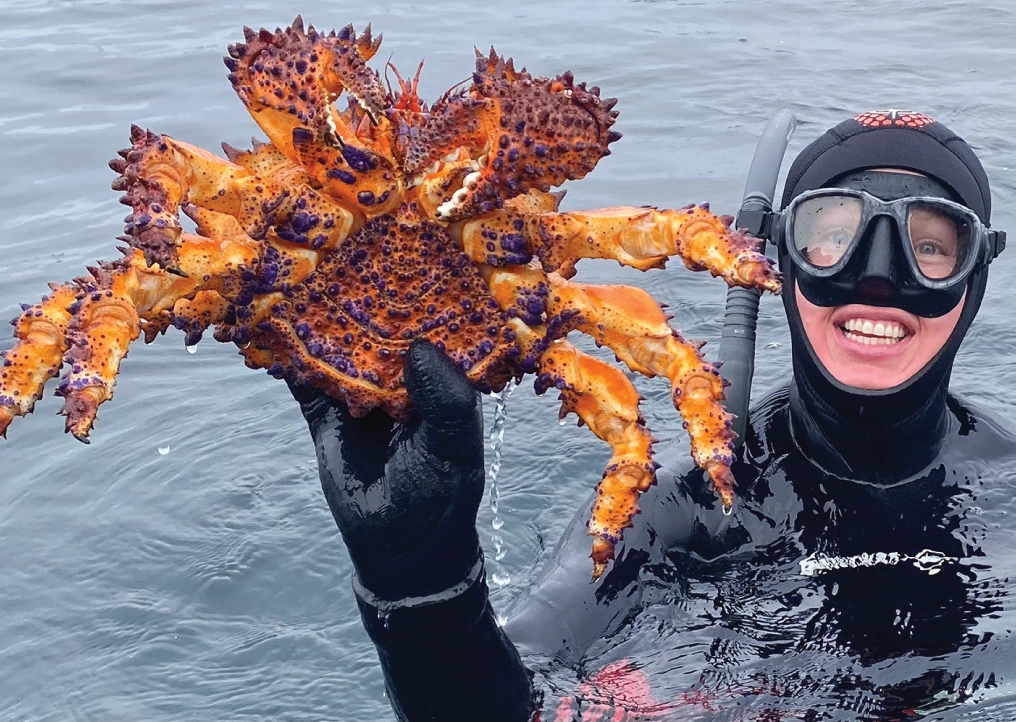
The colours and biodiversity of the ocean around Vancouver Island are phenomenal. Puget Sound king crab is probably my favourite example of nature’s ocean artwork, with their white, orange, red, and purple shades. However, because the red light from the sun gets filtered out of the water first, they’re not easy to spot at depth. Nudibranchs (sea slugs) are another favourite critter; sea lemons are a common and easy to identify dorid type, while body shapes get even more complex and colourful with the bright white-and-orange tipped nudibranch (Antiopella fusca).
“I never know what type of treasure I’ll find, and I’m always guaranteed a calming, quiet, gentle peace that only the water can provide.”
Exploring Strathcona’s Lakes
Freediving in the Strathcona region doesn’t always have to be in the ocean. Lakes are generally calmer, unaffected by tides, currents, plankton blooms, and winds, and with better visibility. In the summer, I’ve even done a few lake dives without my trusty wetsuit; it’s cold, but the freedom of movement and natural buoyancy is a peaceful change. And diving around small submerged standing trees, old fallen ones, and many, many stumps is a unique experience. It’s like gliding in slow motion through our history of logging, damming, and flooding rivers to create lakes and hydroelectric power.
My kids love it when I dive in popular swimming areas to find “treasures” (and clean up garbage). Some recent finds include swimming goggles, sunglasses, dog balls, and a couple of reusable magnetized water balloons. As for me, I love diving because I never know what type of treasure I’ll find, and I’m always guaranteed a calming, quiet, gentle peace that only the water can provide.