




Exploring the remote Alava Bate Sanctuary on Vancouver Island
There are still remote places and hard-earned peaks on Vancouver Island where I get lost from society, and last summer I had the honour of exploring the Alava Bate Sanctuary.
Not for the fainthearted, these prominent red granite peaks were first sighted by European explorers from Nootka Sound. Names were given but the bush was not penetrated for mountaineering until the late 1970s. Tlupana and Tahsis inlets stretch their arms towards the area and logging roads only assist so far.
I was unsuccessful in discovering why it is called the Sanctuary. It is far from a protected area, although it is guarded on all sides by dense bush, forests of devil’s club, deep ravines, and no trails. The half-dozen snow-capped red peaks cascade into impossibly blue lakes and tarns before giving way to wildflower meadows and waterfalls, enticing those who understand the sufferfest approach is worth the gain. Once the lakes are reached, one must still navigate near-sheer rock faces; mountaineering skills and climbing gear are absolutely essential.
Planning the ultimate Vancouver Island bushwhack
This remote wilderness beckons all who crave the isolation, beauty, and climbs of locations where sometimes nobody summits for several years. Being well-versed in Vancouver Island bushwhacks, our group—myself, Tiffany, and Barry—had it on our “must-do” list.
In July last year, we departed from Courtenay. Half an hour short of Tahsis, we turned up a logging road to find it washed out and, to our surprise, another vehicle. The driver, just as surprised to see us, informed us this wasn’t the way to Starbucks. He was a forestry worker, a reminder that the area is not protected and logging would likely continue uphill.
Navigating the challenging bushwhack approach
We parked, crossed over the washout, and ventured up the loose rock road in full sun. Dipping into the forest, we were pleased to find beautiful elk paths and only a light presence of devil’s club. After all the horrible reviews we’d read about the bushwhack in, we found it steep but manageable. (Do keep in mind the three of us have an affinity for suffering, so our perception of “manageable” may be skewed.) After navigating around bluffs, soggy marshes, rivers, and prickly vegetation, we were rewarded when the forest opened into a beautiful open basin under the southwest side of Mount Alava.
Finding paradise at the Shangri-Ohh-La-La tarns
We made a beeline for the “Shangri-Ohh-La-La” tarns. After an hour or so of lounging in and out of their waters like seals, we moved on. We rounded the saddle between Mount Alava and Malaspina Peak, followed Mount Alava’s east ridge, and then dropped into the basin for our final approach to Peter Lake. Following a beautiful alpine stream with multiple waterfalls and deep pools was a lovely way to finish day one. We set up camp at the outflow of Peter Lake and had a quick cleansing swim before dinner and bed, falling asleep to the calming sounds of… gulls? (After the trip, we discovered it’s not that unusual to see herring gulls in the alpine. They build nests under the ice and snow on the steep rocks at Peter Lake’s southern end).
Morning mishaps and beer for breakfast
The next morning we crossed the outflow. As we sat to don our socks and shoes, I heard an unmistakable pssshhh. I reached into my bag and pulled out a beer, now spraying wildly from a puncture hole. We had planned to have a beer “Secret Santa” at Shangri-La Lake, and I’d brought a Gose for Barry. Now, at 7:30 a.m., Barry swiftly popped the tab and gulped my gift. Although I now smelled like a brewery, my beer was happily intact, safely nestled in Tiff’s bag. We continued up the northwest ridge of Mount Alava.
Our plan for the day was to get to the other end of Peter Lake and into the Shangri-La basin. This was not an easy task—we had to climb almost the entire mountain, only to drop back down terrifyingly vertical terrain, traversing loose rock and ice that threatened to disperse us into the lake. Then, as we climbed relatively easily away from Peter Lake, we thought our day’s ordeal must be coming to an end. But Shangri-La was still covered with icebergs. We tried to navigate gnarly rock on the lake’s west side, only to backtrack from a terrible perch. On the east side, a one-foot wide “path” was indicated by a large bear poop.
Setting up base camp and discovering the alpine spa
Eventually, we reached Shangri-La—our beautiful home for the next two nights. With camp set up, and intrigued by rumours we’d heard of a “spa,” we crossed the meadows to find warm tarns. Amazingly, we eventually managed to convince ourselves to leave and gear up for an evening summit of Mount Grattan via the Lifeline couloir and an ominous pinnacle called the Thumb. After a fun, blocky climb, we found ourselves on Mount Grattan’s summit enjoying unbelievable vistas before our return to camp.
Conquering Mount Bate, the crown jewel
The next day, Mount Bate, the crown jewel of Alava Bate, was our goal. The description of the northeast ridge intrigued us, so we made our way up a steep, icy gully, only to turn around at an impassable moat. Defeated, and having lost an hour and a half, we headed to the much longer, but simpler, east face. The weather was hot and the snow sloppy, but after a few hours, we were on the saddle between the summit of Mount Bate and a very imposing gendarme (a rock pinnacle). The loose rock was terrible and only one boulder was large enough to sling. We all clipped in and tried not to slip or kick rocks. Barry led a very airy pitch that seemed to overhang Peter Lake 700 metres below. After some high-fives on the summit, we rappelled down and revisited our spa before bed.
The technical challenge of the Thumb traverse
Our final big climb took us back up the Lifeline couloir as the sun rose. Barry led the first pitch up the “Fingers” of the Thumb. It was great rock, and after two pitches and a small exposed traverse, we were at the bottom of the gully up to the Thumb. This gully was probably the easiest part of the whole Thumb traverse. At the summit, crazy exposure and thumbs-ups all around!
After discussing all options to drop to the Thumbnail part of the climb, Barry set up a body belay (using his body weight to brace against the climber) and slowly lowered Tiff, who set gear as she climbed. I went next, then Barry. Then we found ourselves on a tiny notch with an au cheval (straddling the rock as if on a horse). We crawled, shuffled, and gingerly walked to Thumb Peak.
Bidding farewell to the sanctuary
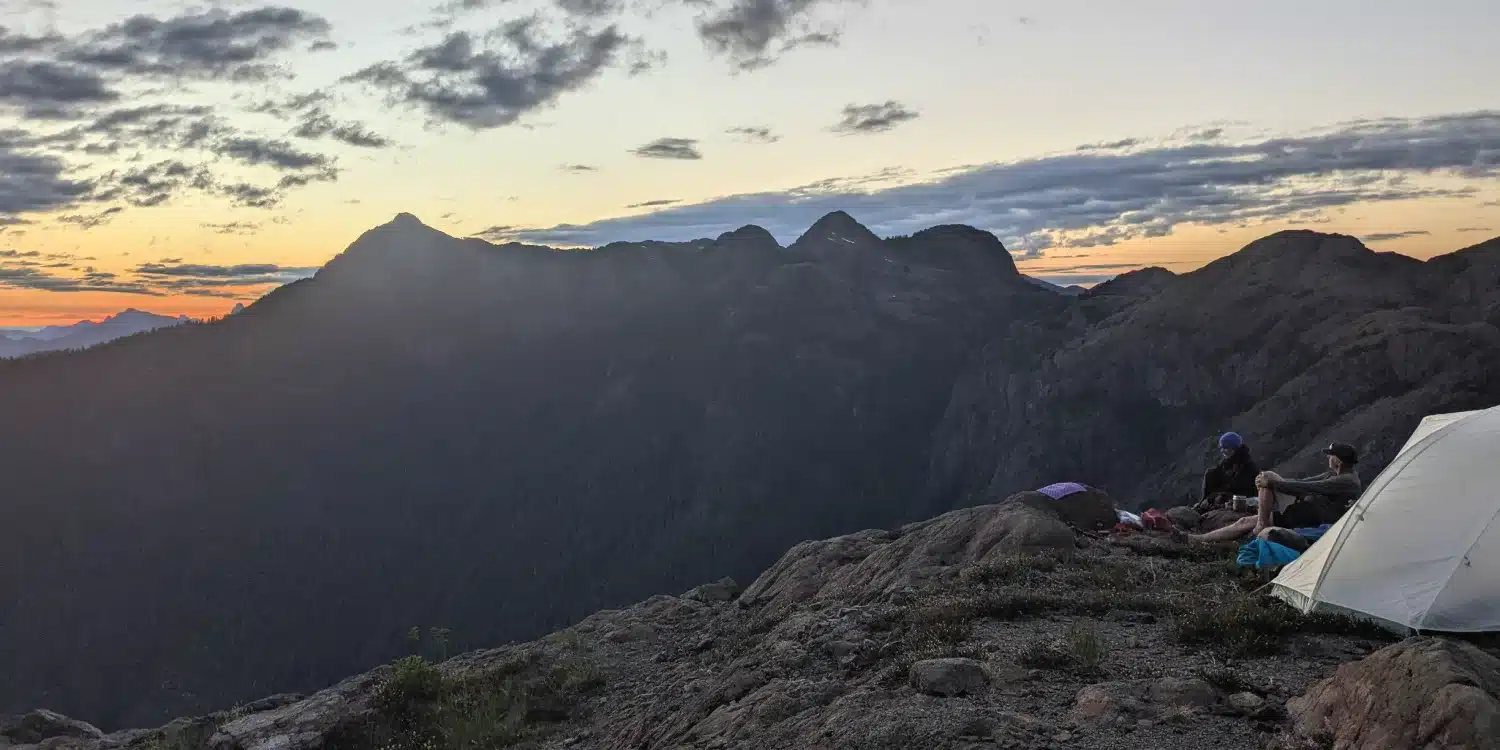
Thumb traverse accomplished, we bid farewell to the beautiful Shangri-La basin and began retracing our steps home. We made it to the high west ridges on Mount Alava (driven by the bugs, which were fierce) and pitched camp to a beautiful sunset, a sweet goodnight to Alava Bate Sanctuary.


