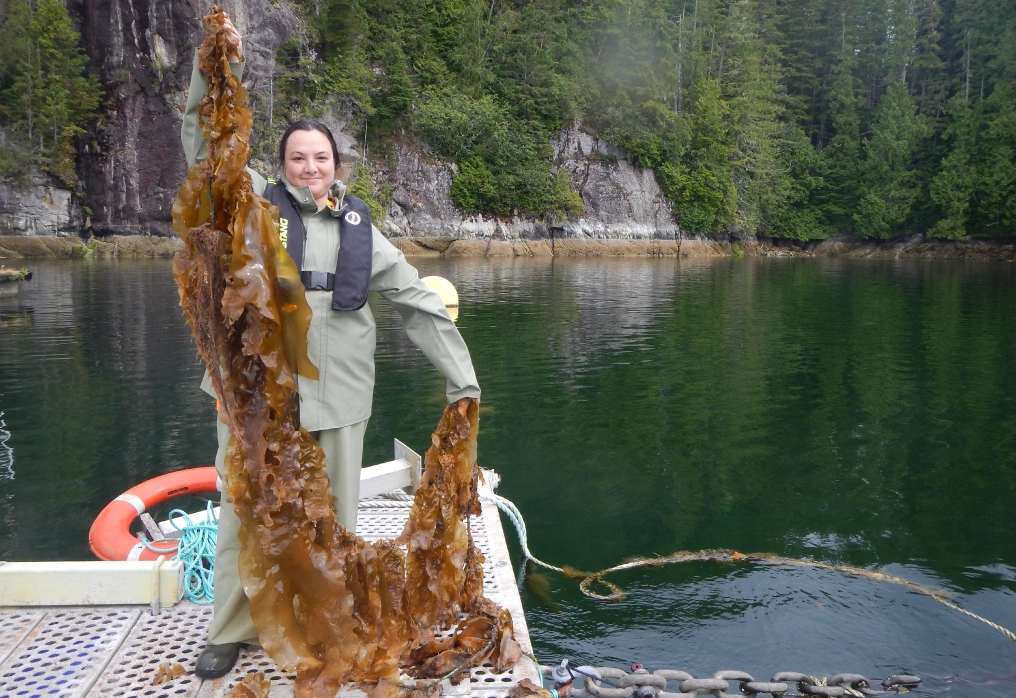

At a time when the ocean truly needs us, seaweed has found its place in the hearts and minds of many. A strange and unassuming organism, seaweed tugs at the imagination and invites us to slip beneath the surface to explore the depth of possibilities that occur when we honour our connection to the ocean. It sparks interest in important questions: how can we support the fish, the climate, and ourselves?
When we are feeling lost, we seek answers and solutions. Sometimes those show up in unexpected places. For me, it was at the shoreline, clinging to rocky outcrops, and beneath the surface in a dimension I had never seen, but recognized like a forgotten memory falling into place. The living species of the intertidal zone are diverse and bizarre. Like every ecosystem and organism on Earth, seaweed has a complex and beautiful role.
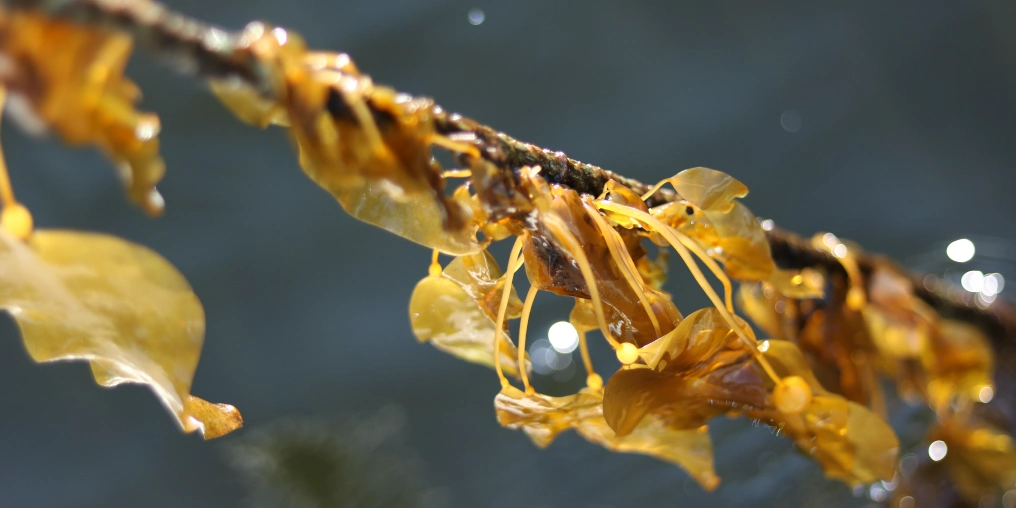
A personal discovery
Seaweed first appeared as scary tendrils skimming my toes in the lakes of my youth. Then it became a curiosity, hiding sea stars and carpeting the path to the waves as I scrambled along the shores of the Maritimes in my early science education days. Then suddenly, on Vancouver Island, where the cold, clear waters became a part of my daily life, seaweed surrounded me. I learned the tides and wind direction, and then my face was below the water, and I saw sunlight filtered through the undulating surface waters, illuminating the brown-green of a kelp blade. How could such a perfect colour exist? I felt it then, the sense of alignment. I had found something that fit into the gaps I was trying to fill—a tangible thread between all the topics I consider important, like the ocean, community, food systems, and sustainability.
“From ocean habitats and food sources to cosmetics and beyond, the hundreds of seaweed species found on the West Coast have many properties that make them a valuable resource.”
An astonishing organism
Seaweed is an astonishing organism, a vital essence of the coast. It answers some of those important questions: it provides sanctuary for juvenile fish, lays a foundation for thriving biodiversity and healthy ocean systems, and ultimately supports the climate.

From ocean habitats and food sources to cosmetics and beyond, the hundreds of seaweed species found on the West Coast have many properties that make them a valuable resource. Given these attributes, there are many ways seaweed can fit into our lives. We can eat it, harvest it, photograph it, monitor it, and nourish ourselves with it.
It can create jobs and contribute to an economy more in harmony with a thriving ocean. The possibilities are vast. Seaweed might not save us, but it will help us.
Building a seaweed future
There is a collection of individuals, organizations, First Nations, communities, and businesses working toward a future entwined with seaweed. I am grateful to know them and be among them, those who have found themselves drawn to this peculiar lifeforce in the water. My working life has led me to positions that support the multifaceted nature of the seaweed sector.

Seaweed research at North Island College
Today, I am the Senior Research Technician in the Centre for Applied Research, Technology, and Innovation at North Island College. Here, I have found a way to engage and collaborate with many dedicated and creative people through applied research, framed by those important questions that will build a stronger future for the Earth and all its inhabitants.
“In the lab, we test nursery methods to develop the best way to grow seaweed for successful cultivation and restoration.”
Our Seaweed Innovation Hub is funded primarily by the government of Canada through the National Science and Engineering Research Council and PacifiCan; the Government of British Columbia through the Future Ready Action Plan; and the Canada Foundation for Innovation. We work both within the technical confines of our seaweed lab and out on and around the water, working with partners to observe and learn about seaweed in its subsurface home.

In the lab and in the field
In the lab, we test nursery methods to develop the best way to grow seaweed for successful cultivation and restoration, learn to store the seeds of various seaweed species to understand genetic attributes, and test processing methods to make seaweed easier to incorporate into a variety of products.
In the field, we harness ocean technology to monitor seaweed habitat, collect critical data for understanding water quality, and meet with people who know seaweed in ways that we do not.
Some people and communities have known seaweed all along, and some people have recently found seaweed. I am one of the latter, and well aware of myself, entangled in the holdfast of seaweed. I know that most people walk along the shore, contemplating their questions, and the seaweed does not speak to them. That is fine—their answers lie elsewhere, waiting to be found.