

In addition to her love of art, she was also drawn to math and science, and for a few years, she studied biology at UBC before being accepted to Emily Carr University of Art + Design to pursue a four-year Bachelor of Fine Arts.

Finding her medium
Gregory expected to focus on painting and sculpture at Emily Carr, but she fell in love with clay, and after graduation she opened her own pottery studio. For many years, she did the kind of functional work that she describes as “the potter’s bread and butter”: mugs, bowls, plates, tea pots, all done on the wheel.
Then she got into making porcelain lighting. She was drawn to the translucency of porcelain, but she needed to change her process to achieve the size, thinness, and translucency that lamps need. Porcelain can be a challenging material, she says. “It’s finicky and tends to crack if not handled perfectly. It’s persnickety.”
What is slip casting?
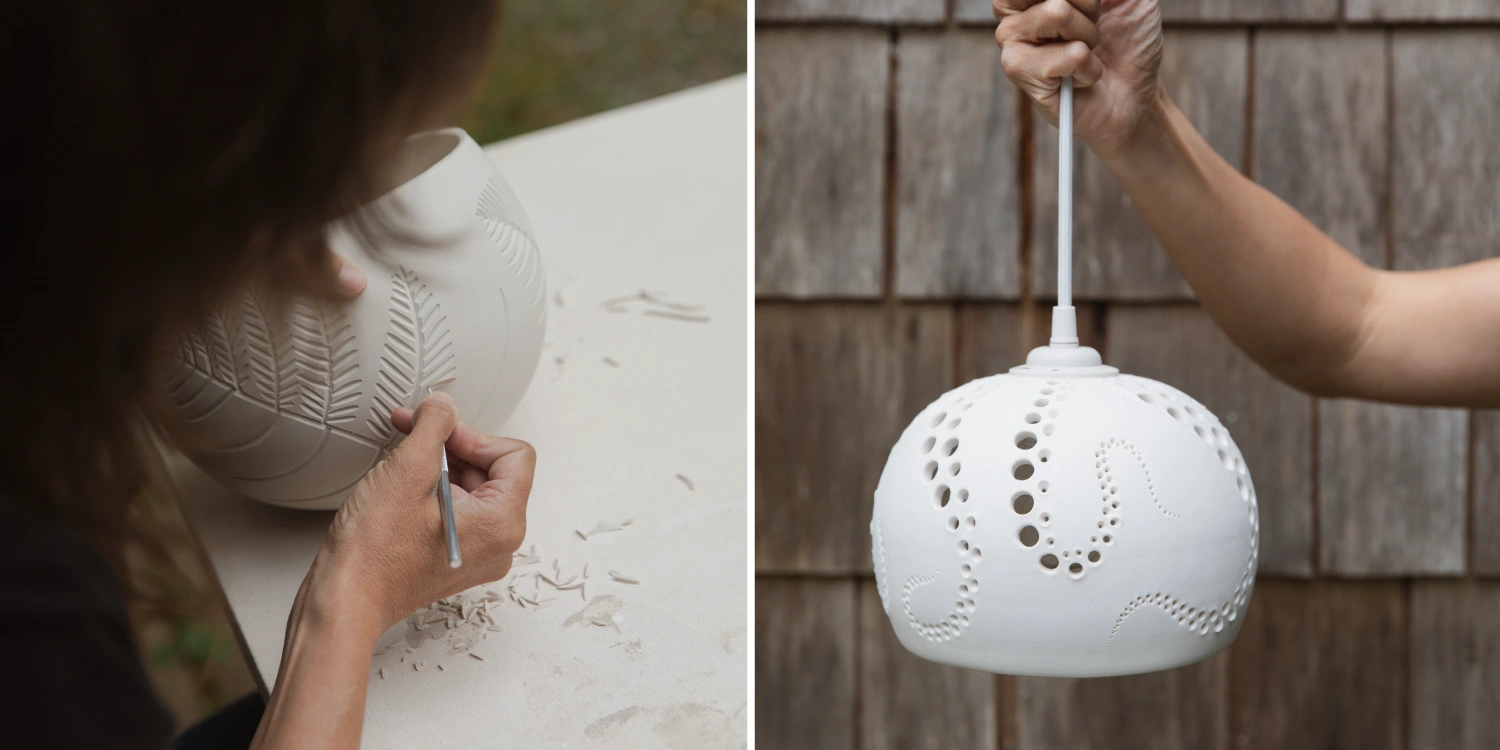
A process called slip casting (or slip cast ceramics) proved to be a great solution. Each lamp starts with a desired protoype shape made either by hand or on the wheel, or sometimes a combination of the two. Then Gregory builds a multi-part plaster mold from this original.
Once the mold is made, she fills it with liquid porcelain, called “slip”—a slip cast approach that ensures consistency. As the slip dries, a shell of hardened clay forms. When the excess slip is poured out (and saved for future projects), it leaves a perfect blank lamp in the shape of the original.
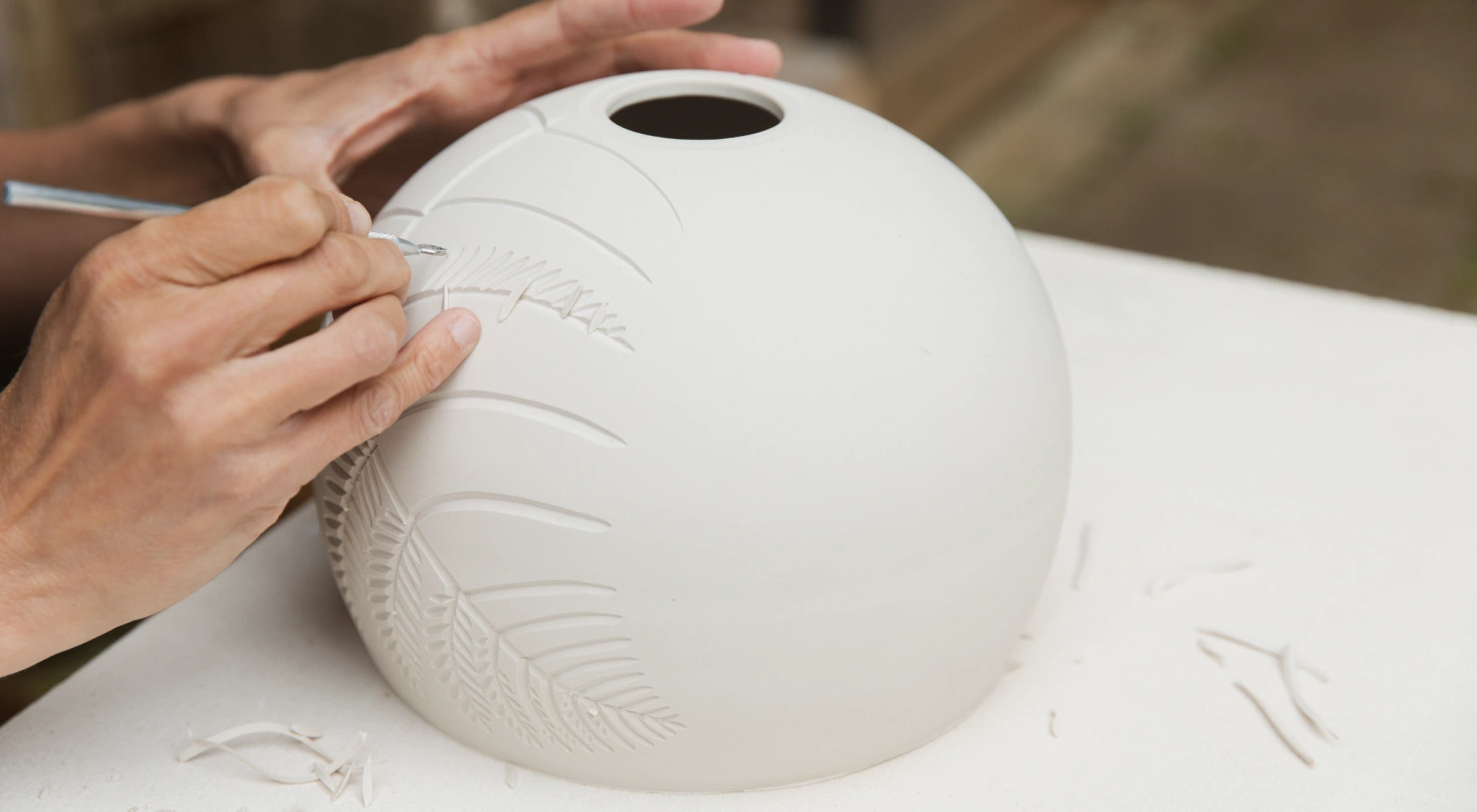
Gregory then carves every blank lamp by hand, which she admits “is my favourite part.”
From concept to finished lamp
There are a lot of steps involved in getting to a successful prototype. “For example, for wall sconces, it may take a year to get from the concept to a functioning sconce on the wall,” she explains.
She delights in making functional objects that are also works of art. With a well-designed mold, she can make batches of lamps with the same shape, each with a unique pattern.
Her designs are often inspired by botany, sometimes by rock formations, and occasionally by animals (for example, her whimsical octopus lamps).
Recently, Gregory retrained to become a teacher, and she now works as a teacher on call. When she’s not in classrooms at various Comox Valley schools, she can be found in her Merville studio, most often focused on the custom orders that now form the bulk of her work. “I love being able to spend time on larger, more intricate pieces,” she says.
She mentions offhandedly that she still paints, “but not as a job.” She describes herself thus: “Basically I’m interested in everything, and sometimes it’s hard to do everything,” which convinces me that her artistic practice will continue to evolve. But for now, her work is all about making the world a bit brighter and more beautiful.
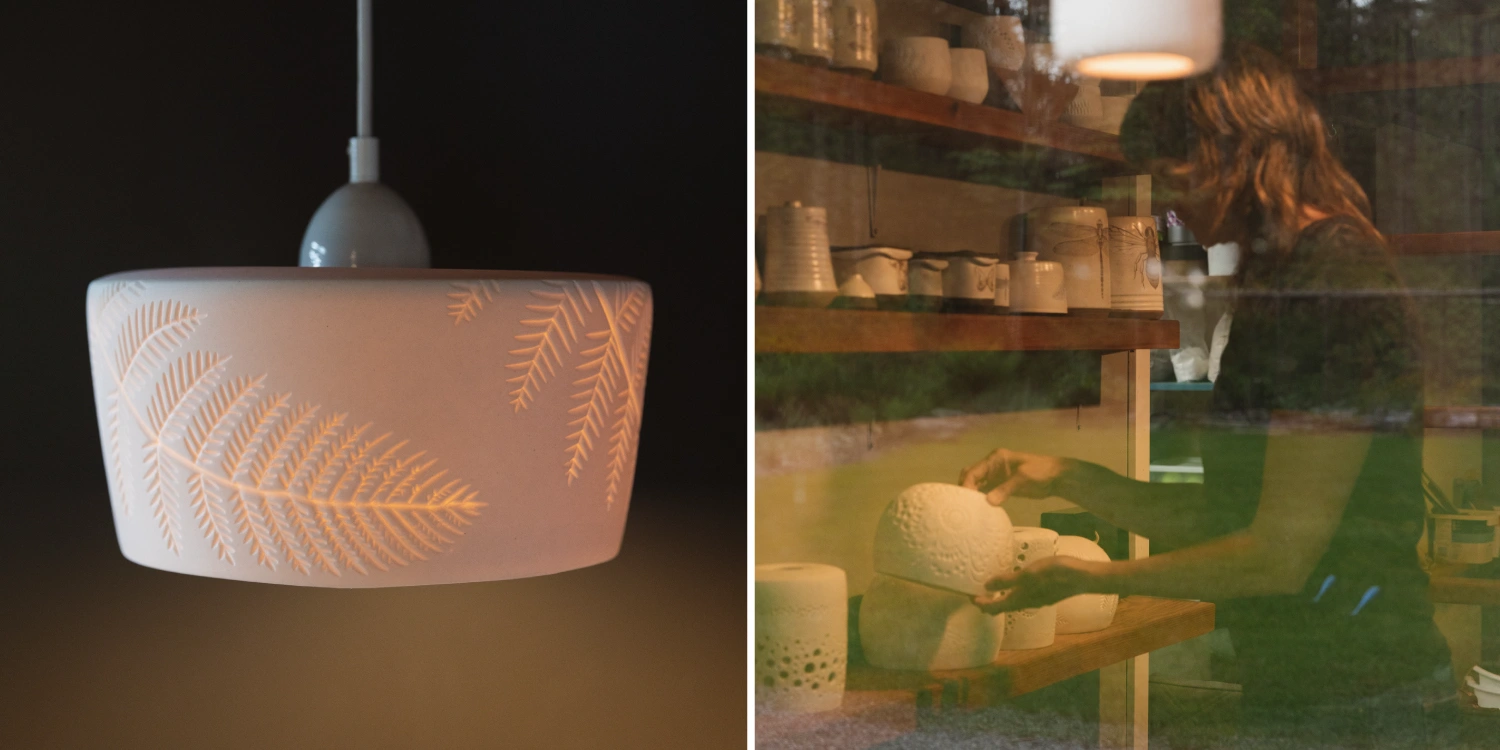
To see more of Ramona Gregory’s work visit RAMONAGREGORY.CA.