
In July of 2024, nine of us from the Tōshikan Traditional Karate and Kobudō dōjō in Courtenay travelled to Okinawa, Japan, to experience the culture and physical training of their traditional martial arts. (Karate-dō means “the way of the empty hand” since it’s practiced without weapons, while Kobudō practitioners use traditional weapons, mostly modified farming and fishing implements.)
The culture of the Okinawan islands remains strong, and, in many ways, distinct from the rest of Japan. This makes it s a special place to visit.

Understanding Okinawa’s cultural foundation
Okinawa, meaning “sea rope,” was historically known as the Ryukyu Kingdom. It is an archipelago of about 160 islands stretching in a 1,000-km line between the mainlands of Japan and Taiwan, with the East China Sea on one side and the vast Pacific Ocean on the other.
The place has an indigenous population, but it has always been influenced by Japan, China, and Taiwan. In the 1600s, the Ryukyu Kingdom lost its independence and became a vassal state to Japan.
From Courtenay to the birthplace of karate
The trip in the summer of 2024 was my fourth visit to Okinawa. On previous visits, I’d attended two Budōsai—traditional martial arts festivals—and spent time learning from my sensei.
This time it was my pleasure to travel with eight students from my dōjō: Myla Behzad, Stuart MacKenzie, Pam Powell, Bailey Quast, Toby Quast, Andrew St. Hilaire, Mike Thompson, and Roberta Wesley. It was particularly special for my students, since it was their first time in Japan, and Behzad’s parents and brother came along to make it a family vacation, as well as MacKenzie’s wife.
Powell, a Tōshikan senpai (assistant instructor in the dōjō), says, “the most rewarding aspect for me was being able to share this experience with so many dōjō friends.”
“It was a truly memorable experience to perform kata in unison with over 700 people from all over the world. I can still hear and feel the power of the resounding kiai!”
– Toby Quast
700 practitioners, 50 countries, one unforgettable experience
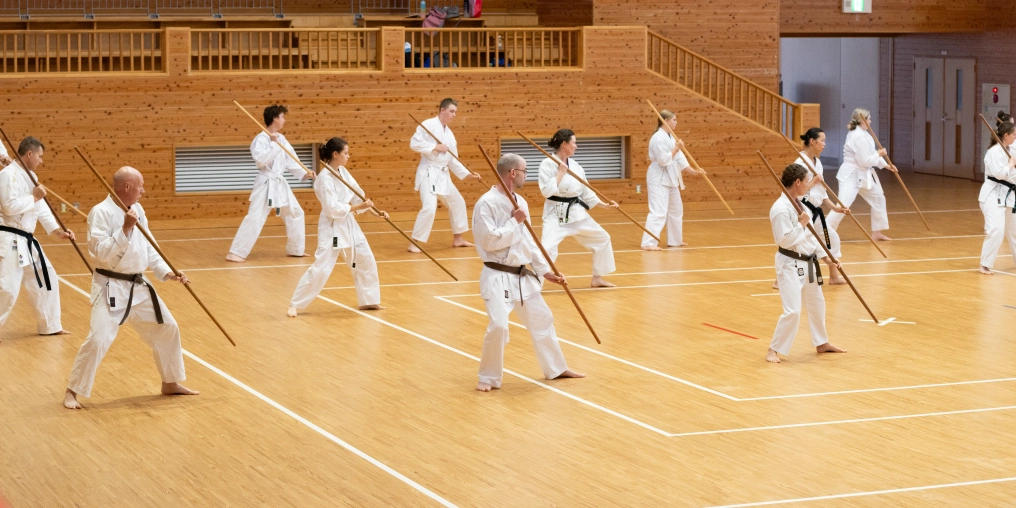
Our Courtenay dōjō belongs to the International Okinawa Goju-ryu Karate-dō Federation (IOGKF), which holds a Budōsai in Naha, the capital of Okinawa, every four years. The event takes place in the Budōkan—a martial arts stadium and training centre built in the shape of a samurai helmet—and is led by Okinawan masters and international chief instructors. The 2024 Budōsai welcomed IOGKF members from about 50 different countries. For Toby Quast, “it was a truly memorable experience to perform kata [a system of self-defense movements and techniques] in unison with over 700 people from all over the world. I can still hear and feel the power of the resounding kiai!”*
Dreams fulfilled in Okinawa karate’s homeland
Visiting Okinawa had been a dream of Powell’s since the late 1990s, when she trained in a different style of traditional karate: “When the IOGKF World Budōsai was announced last year, I finally took the opportunity,” she says. It was also a dream come true for two other Tōshikan members, Andrew St. Hilaire and Stuart MacLean, who tested for their first-degree and second-degree black belts, respectively—and passed! (I know from experience that it is particularly special to be tested in the birthplace of karate-dō and kobudō.)
One of the youth dōjō members, Behzad, says “the experience was incredible,” adding that she “enjoyed meeting people from other parts of the world, and learning and training with them.”
Beyond the dōjō: discovering traditional martial arts culture
Outside of training, there was time to explore and enjoy the landscape and seascape; social gatherings; cultural places, such as Shintō temples, castles, and gardens; and historical sites associated with karate-dō and kobudō.
“Going to Okinawa for this global gathering made our local community of practitioners feel like part of an international family—one with a lineage tracing back to ancient times.”
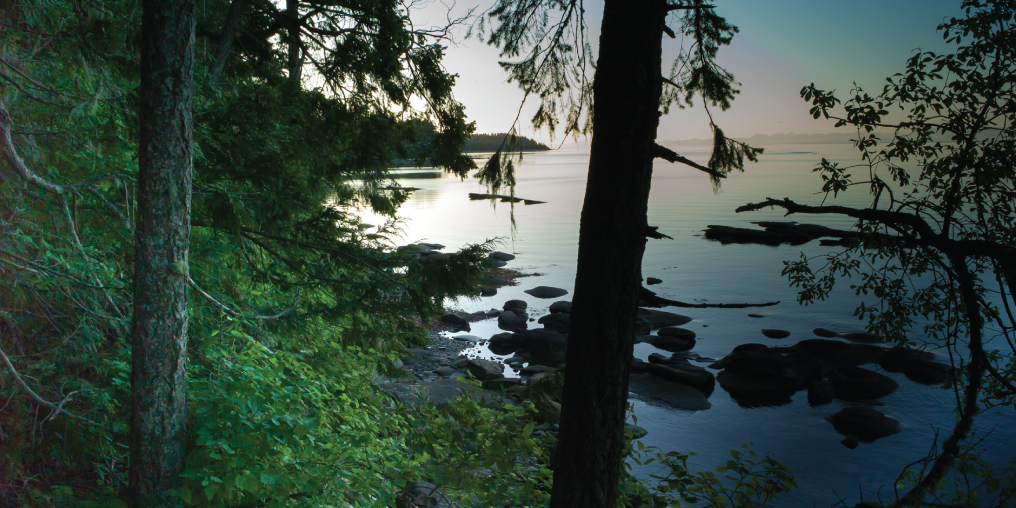
Okinawa has a subtropical climate, so it’s very hot in July, with humidity close to 100 per cent. Outside the urban areas, vegetation is lush: vibrant green, filled with flowering bushes and trees. My favourite time for walking Naha’s city parks is night. It’s cooler, and I enjoy spotting bats—some the size of ravens, others as big as eagles.
As Thompson remembers, “The social side of things was great. The chance to have some down time in the afternoon with friends, explore Naha, and be immersed in the karate cultural tradition was another plus, along with the superb food and shopping.”
How Okinawan traditions transformed our local practice
For me, travelling to the place where our martial arts practices originated generates teaching ideas that I bring back to the Tōshikan dōjō. All of us who went felt the experience inspired our continued training and development.
Going to Okinawa for this global gathering made our local community of practitioners feel like part of an international family—one with a lineage tracing back to ancient times. It reminded us that the culture of traditional karate-dō is based in reigi, the values of courtesy and respect.
And we will never forget how the Budōsai in Okinawa is the fullest expression of the karate-dō motto: “Train hard, have fun!”
*a spirited shout used in karate kata