




North Island College student housing brings culture and community to campus
When NIC student housing opens this fall, the first thing many will see as they approach is a frog.
The image, based on a frog button blanket, is the creation of K’ómoks artist Pamela Mitchell and will grace the façade of the new NIC student housing entrance, with its passageway known as the Knowledge Bridge. The artist calls the work “the knowledge keeper” because the frog is known for its adaptability and knowledge.
“Frog brings great wealth and power as he travels and lives in the two worlds, water and land,” she says in a statement.
Further, the button blanket represents home and family who uphold students on their journey while celebrating their achievements in life.
Tul’al’txw: Honouring indigenous culture in a student housing
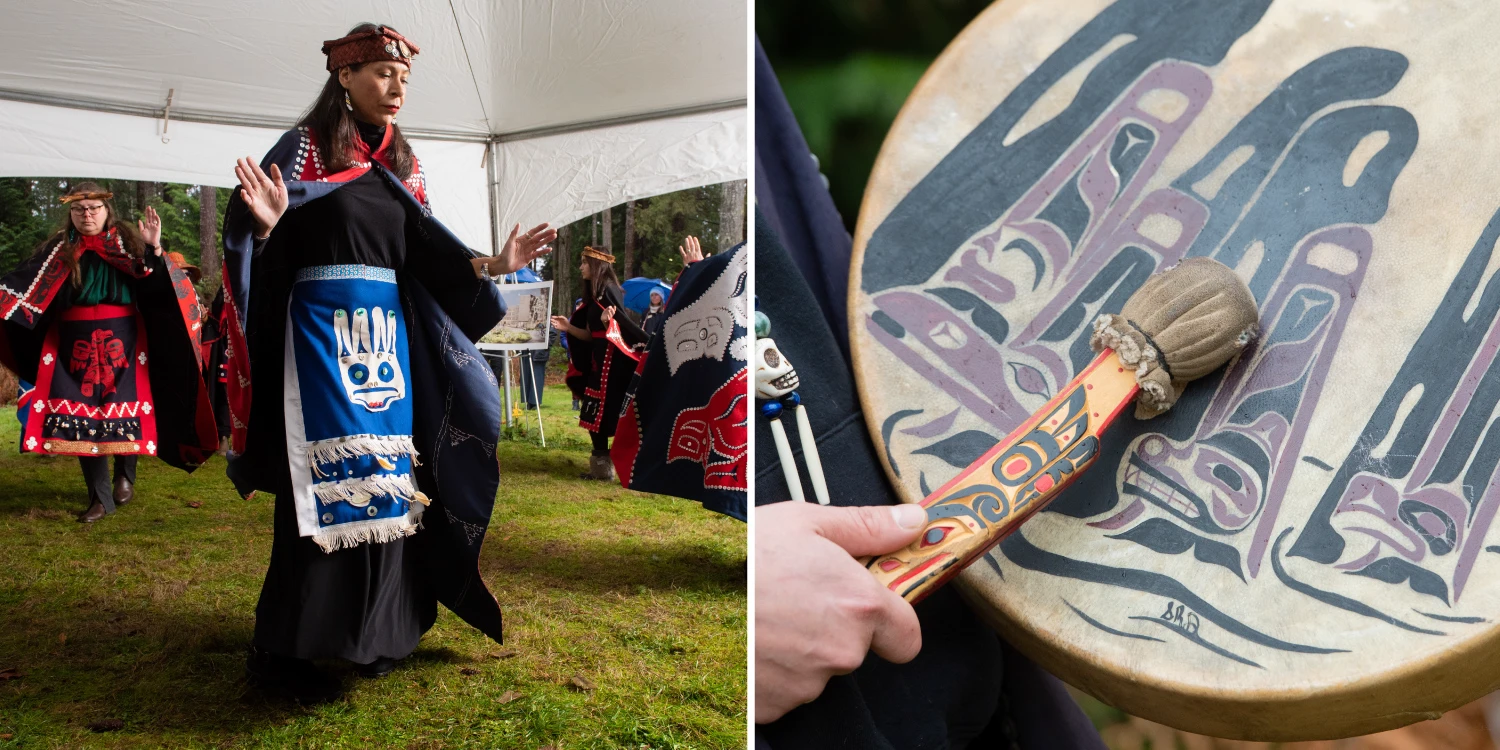
Mitchell’s work sets the tone throughout the site, known as tul’al’txw, or “house of learning.” She is working on another piece, a hand-painted mural honouring all K’ómoks tribes with animals representing family crests.
“The crests I chose to represent all the tribes are the large double-headed sea serpent that will span the whole length,” she says. “It will have the whale, bear, eagle, thunderbird, sun, and moon.”
Trevor Hardy, another K’ómoks artist, is designing a two-headed thunderbird for the front doors. He uses a lot of Coast Salish influence in his work, because he finds that tradition a bit more open to other elements.
As a carver, he started at age 10 and learned the craft from his grandfather and uncle, though he says he has long been a “wood bug.”
“Artwork comes from the mind and the heart,” Hardy says.
Collaboration for inclusive housing
For North Island College, the project displays its commitment to Indigenization. It started with discussions with K’ómoks First Nation (KFN) about what would be “welcoming” for Indigenous students. A K’ómoks Connections Committee was established, with representation from the Indigenous and college communities.
“When the design-build team was chosen, that’s when this committee was established,” says Kelly Shopland, NIC Executive Director, Indigenous Education.
Urban One has overseen the building’s construction, while the engineering firm HDR provided the design, including its many Indigenous features. The committee serves as the voice to ensure the project stays committed to Indigenization in all the details, like welcome poles at the entrance.
“We have greatly enjoyed working alongside North Island College, Urban One, members of the K’ómoks First Nation, and our engineering design partners to develop housing that pays respect to the local Indigenous influences, deepens connections with traditional territories, and ultimately brings access and opportunity to the college’s diverse student body,” says HDR’s Matthew Emerson, Architect AIBC.
The design of tul’al’txw includes a Gathering Place inspired by traditional big houses with wooden benches, copper meshing and cedar slats.
Comox Valley student housing with a sense of belonging
Between each of the buildings there are passages: the Land Passage, the Origins Passage, and the Knowledge Passage. At the back is the building for students with family, which can include extended family or individuals with whom the student has a supportive relationship. At the front, the Knowledge Bridge includes different levels inspired by the three stages of traditional K’ómoks First Nation ceremonies, and it connects the east and west wings for individual students.
“It’s infusing culture, it’s infusing language,” says committee member Erin Higginbottom, who also works with KFN. “The thought that goes into these details has been exceptional. I like to think this is going to be an exemplary model of all housing, how all buildings are designed, not just at North Island College, but perhaps far and wide.” Although the housing is open to all students, applications from Indigenous students and former youth in care will be prioritized.

Indigenizing education: a place of belonging at North Island College
Comox Valley campus Elder-in-Residence Fernanda Paré, who also sits on the committee, recalls that inclusion of Indigenous people and culture was not part of education at all for a very long time. Even when she started at the college 11 years ago, she noticed there were never any pictures from the Indigenous communities, which makes the current collaboration all the more relevant.
“To imagine that today, we’re actually doing a little bit of Indigenizing the institutes,” Paré says. “Sometimes, I can’t believe I sit here and I have a voice. To imagine that now Indigenous students will have this place, a sense of belonging, and feel good in their hearts to be here and that they’re okay, they’re in a safe place. It means everything when you come from a background of residential school.”
As construction of the 217-bed housing site nears completion, NIC has been taking applications for the fall. The opening ceremony for tul’al’txw is set for September 19.
Each building will be gifted its own traditional name, to be revealed at the opening, and for members of the committee like Fernanda Paré, this moment will come as a truly welcome arrival, as if moving from an old world into another brand-new one.
“I can’t even explain in my heart how much this means to me,” she says. “I feel very grateful.”


