Jeff Groat is the Outreach and Food Security Organizer for Greenways.
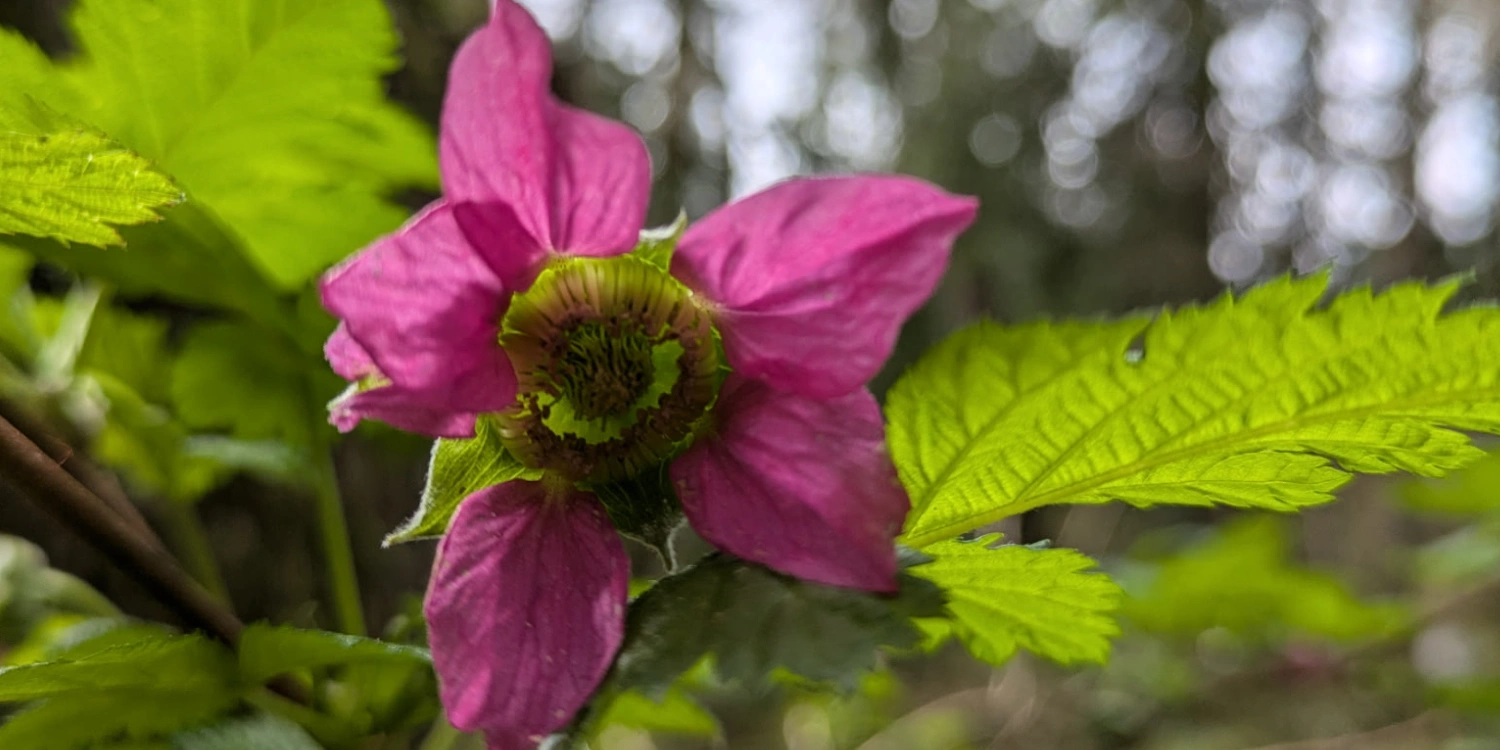
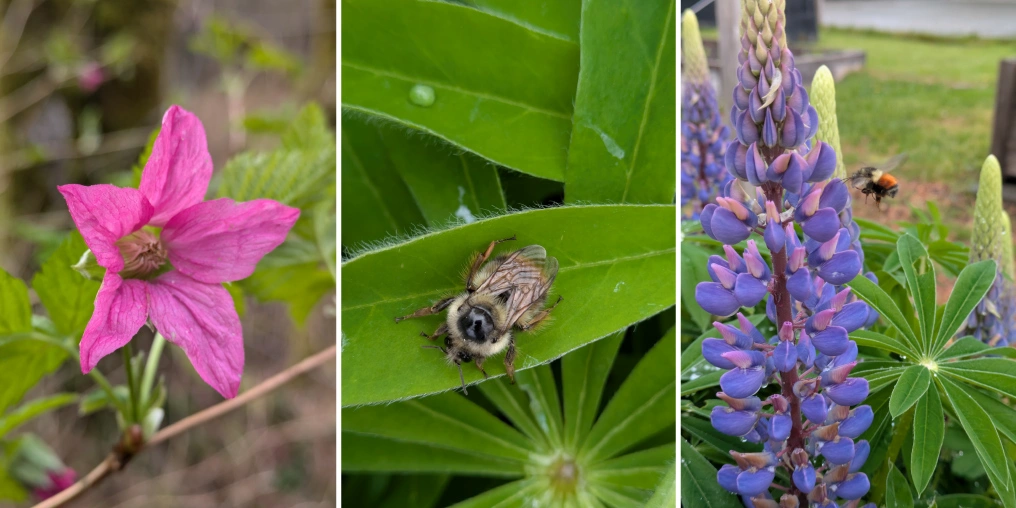
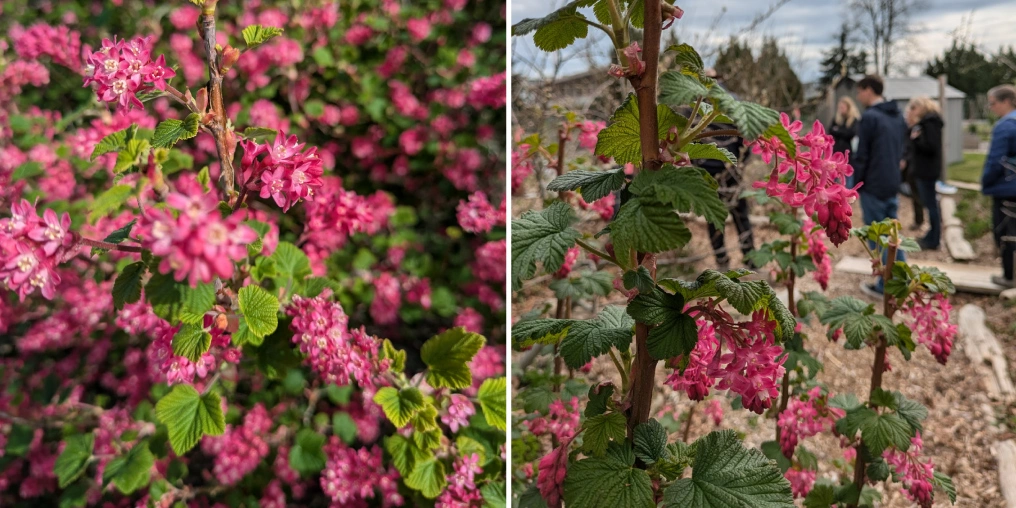
Every spring on the West Coast, bright magenta salmonberry flowers pop open among the first buds of green growth, bringing welcome bursts of colour into the reawakening forest. Around the same time, streaks of buzzing, cinnamon-dusted rufous hummingbirds return from their holiday in Mexico to seek out the sweet nectar provided by these and other coastal spring flowers.
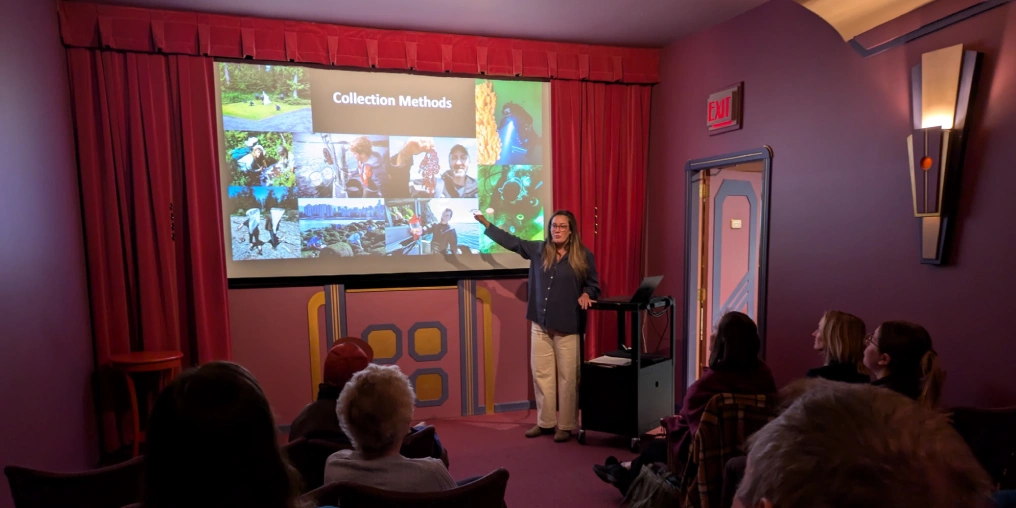
Amid the flitting activity, you may see local naturalists armed with field guides, smartphones, hand lenses, and a deep sense of curiosity taking part in Greenways Land Trust’s upcoming Salmonberry Nature Festival. In greenspaces around Campbell River, participants will take part in a series of guided outings and expert-led talks as part of this celebration of local biodiversity.
In 2025, Greenways launched its first-ever Campbell River Bioblitz, an organized initiative to facilitate community science and data collection using the iNaturalist app.
What is a bioblitz?
A bioblitz is an intensive period of biological surveying where community members work at their own pace to document every species they can find in a defined area. It’s part scavenger hunt, part scientific research, and entirely accessible to people of all ages, abilities, and backgrounds.
In 2026, Greenways is expanding the Salmonberry Nature Festival, with a wider variety of outings and talks running concurrently with the updated iNaturalist bioblitz initiative. This festival comes at a milestone moment for Greenways, forming part of a year-long series of events celebrating the organization’s 30th anniversary. Earlier this year, we launched the celebrations with a January open house and organized panel talks led by local women scientists in February to mark the International Day of Women and Girls in Science.
“It’s no secret that Campbell River is blessed with immense natural wealth. Logging and fisheries have sustained the city economically in modern times, but the abundance of the area’s rivers, creeks, streams, and forests sustained Liğwiłdaxw populations and their ancestors for millennia”
30 years of Greenways in Campbell River
Since 1996, Greenways has stewarded local green spaces in Campbell River. As we look back on the past three decades of stewardship and plan for the next three decades and beyond, we’re continuing what has long been one of our greatest strengths—empowering residents to become active participants in appreciating and protecting the ecosystems they live within.
It’s no secret that Campbell River is blessed with immense natural wealth. Logging and fisheries have sustained the city economically in modern times, but the abundance of the area’s rivers, creeks, streams, and forests sustained Liğwiłdaxw populations and their ancestors for millennia.
More recently, the eco-tourism industry has evolved from the Tyee Club, which attracted tourists and celebrities to fish from the iconic Tyee rowboats in the 20th century, to the wildlife tours that draw thousands of people from around the world in the 21st century.
Campbell River’s history has long been influenced by the natural world. Yet by the 1990s that relationship had reached a breaking point. At that time, the environmental movement reached unprecedented visibility in British Columbia as Pacific fish stocks began collapsing and large-scale protests in Clayoquot Sound drew global attention to destructive logging methods that threatened the province’s prized old-growth ecosystems.
Today, Pacific salmon stocks have declined by as much as 70 to 93 per cent since the early 1990s, according to the Pacific Salmon Foundation, while productive old-growth forests continue to dwindle.
Bob Dice, a Greenways director from 1999 to 2025, most recently serving as its president, compiled a brief history of the organization from its inception in 1996. He notes that decades of resource extraction had set the stage for environmental action. “In Campbell River, industrialization had degraded the estuary, and population growth threatened its urban streams,” he writes. When archived documents revealed a 1931 land donation for experimental forest management, the resulting “Battle of the Beaver Lodge” ended with the province placing the lands in trust. In response, the city began experimenting with a “Greenways concept” in development planning, directly leading to the creation of the Discovery Coast Greenways Land Trust.
What emerged was a coalition of unlikely allies. Planners, developers, fisheries officials, naturalists, sport fishers, businesspeople, foresters, and concerned citizens came together with a shared vision. On October 30, 1996, Greenways was formally incorporated as a registered charity with the authority to hold conservation covenants.
The early years were promising but fragile. Government funding from 1997 to 2005 supported key staff, but when it ended, Greenways was forced to lay off most staff and narrowly survived from 2006 to 2011. The crisis reshaped the organization, which expanded its focus to restoration, education, and food security, and became “the vehicle that enabled local volunteers to express their commitment to the environment,” as Dice notes.
This volunteer-driven model proved resilient. Beginning in 2017, new funding allowed Greenways to grow, averaging nearly $1 million annually through 2025 and supporting major projects such as eelgrass restoration at the Mill Pond adjacent to Baikie Island. Yet the lesson of those lean years remains clear: long-term sustainability depends on diverse funding and deep community engagement.
A pillar of our success has been our ability to connect with community members at their level, inspiring appreciation and sparking curiosity among students, volunteers, and the public at large through a wide range of community events, including our own, and alsothrough the outings we organize each year.
The Salmonberry Nature Festival
Salmonberry Nature Festival embodies Greenways’ evolution and vision for the future. Scheduled for May 4–10, 2026, the festival transforms environmental stewardship from an abstract concept to hands-on action using iNaturalist.
This free community science app allows anyone with a smartphone to photograph and identify plants, animals, and fungi. Its powerful image-recognition technology provides instant suggestions, while a global community of naturalists helps verify identifications. Submitted observations become part of a permanent, publicly accessible database used by researchers, conservation organizations, and land managers worldwide.
By allowing identification among everyday community members, a wide net of observations can accumulate quickly to provide real-world data for all kinds of scientific research. Some folks bring their phone on their morning walk to identify budding trees, while others utilize special equipment and camera lenses to document tiny arthropods, such as springtails, that occupy hidden niches across natural and human-built landscapes.
The festival will feature expert-led workshops on topics from pollinator identification to migratory birds, guided walks through diverse local ecosystems, and educational resources designed to help participants make meaningful contributions to conservation science.
“Every participant who creates an iNaturalist account, every family that spends a Sunday afternoon exploring a local trail with new eyes, every student who discovers a passion for ecology becomes an ambassador for the natural world”
Why community science matters
The data generated during the bioblitz will provide a snapshot of Campbell River’s biodiversity in 2026, creating a baseline against which future changes can be measured. It will inform conservation strategies, support urban planning decisions, and contribute to our understanding of how local ecosystems are responding to climate change and human actiavity.
Environmental stewardship isn’t something that can be outsourced to government policy or conservation organizations alone. It is successful when communities know their local ecosystems intimately and notice when the salmon runs are low or when the cedars show signs of drought stress. It requires children to grow up understanding that the forest behind their school isn’t just unused land, but a complex web of interconnected life.
The Salmonberry Nature Festival represents a model of environmental stewardship that multiplies Greenways’ impact through community participation. Every participant who creates an iNaturalist account, every family that spends a Sunday afternoon exploring a local trail with new eyes, every student who discovers a passion for ecology becomes an ambassador for the natural world and advocates for its protection.
What hidden gem will you identify? To learn more about upcoming outings and talks as part of Salmonberry Nature Festival, or to support Greenways Land Trust’s 30th anniversary fundraising campaign, visit our website at www.greenwaystrust.ca