
Now Cliffe and Sharkey own and operate their own business, CorVee Forest Foragers. Named by their son Jake and a combination of Cory and Vanessa, CorVee embodies their collaboration. They responsibly harvest devil’s club, birch, old man’s beard, turkey tail, and more from Cliffe’s traditional ancestral territory.
As a member of the Laichwildaux Nation and a land steward, Cliffe shares his knowledge of West Coast plants, while Sharkey, who is Manitoba Cree and Filipino, brings a wealth of wisdom from the East Coast. Together, they teach workshops and excursions about traditional medicine, with the goal of protecting the land.
Learning devil’s club is medicine, not a nuisance
As someone who always loved the outdoors, Cliffe’s route to CorVee was winding—and covered with devil’s club, a self-protecting plant with a long stalk, broad leaves, and a spiny surface.
“I was a forester for a strategic natural resource company, and for years I used to cut devil’s club and kick it out of the way,” Cliffe shared.
One day, while visiting his uncle, Cliffe watched as he made a salve from the plant that was so often in his path. When Cliffe remarked that he often bushwhacked devil’s club, his uncle lit up.
“For such a gentle guy to turn around and smack me in the back of the head, that meant I really screwed up,” Cliffe recalled. “He said, ‘What do you think you’re doing? That’s medicine,’ and I started to learn about it.”
He learned that devil’s club is primarily used for pain relief, and can be made into a salve or ointment to treat arthritis symptoms and muscle pain, aid in surgery recovery, and more.
How a shared passion became CorVee Forest Foragers
It was also the connection point for Cliffe and Sharkey, who were both using it to make ointment, something atypical for people their age and usually done by Elders. After a while, folks began to request their salves, and CorVee was born. Over time, business picked up as customers shared how well their products worked, particularly for things that pharmaceuticals had not solved.
“It’s become our goal to help people live more naturally off the land, mainly to get away from pharmaceuticals,” Sharkey explained. “But besides making medicine, our number one thing that we love to do is teach people how to do this on their own.”
“The plants out here, they’ve always been here. The need is there to show people that they can do it.”
— Vanessa Sharkey
Teaching people to forage on their own
To that end, CorVee hosts no-cost foraging days where participants learn how to harvest responsibly and ethically. The mindset behind offering these financially accessible experiences and sharing traditional knowledge free of charge is simple: “The plants out here, they’ve always been here,” says Sharkey, who sees it as her responsibility to show others how to use these plants, which have been growing for millennia.
“The need is there to show people that they can do it,” she said. “They can do it on their own with a little bit of guidance. But we’re also here to teach people how…not to ruin the environment they’re in, how to show respect to the traditional grounds that they’re on.”
Harvesting with the 30 per cent rule
With this philosophy, CorVee uses the 30 per cent rule, never harvesting the majority of any plant. For all plants, they only harvest what is in season and plentiful. When it comes to devil’s club, they leave the mother plant, which grows horizontally along the ground while producing the stalks, leaves, and berries that they harvest to make salves and tinctures.
“Just sticking to that 30 per cent rule, you can then visit that tree again at 1,200 years old.”
— Cory Cliffe
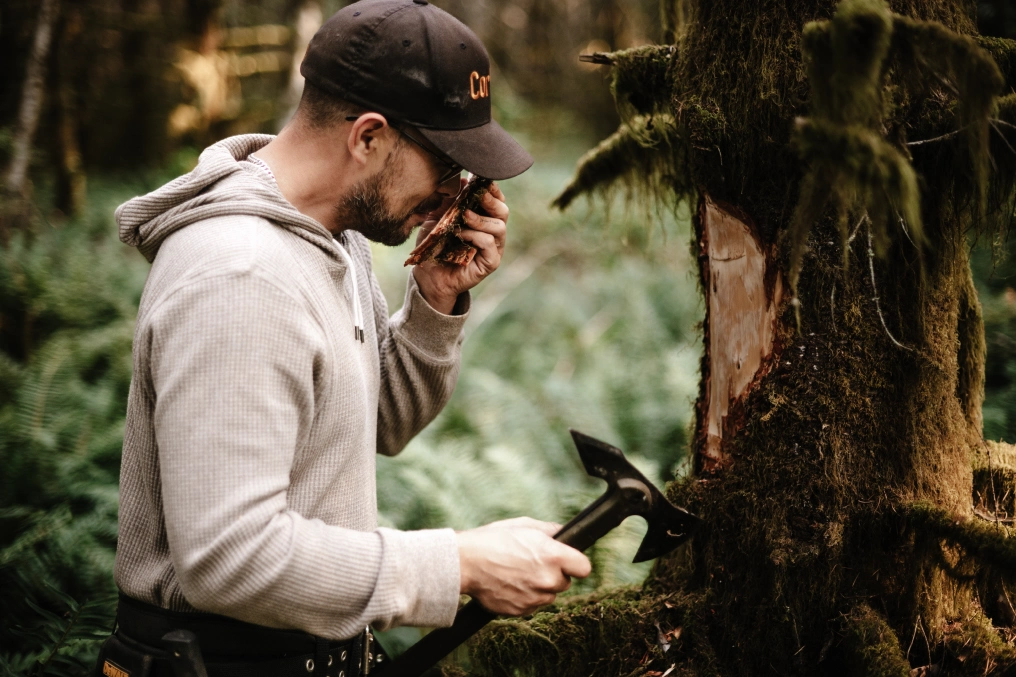
Other elements of CorVee’s philosophy include educating participants with traditional knowledge, such as providing an offering and doing a prayer before peeling red cedar. Protocols to protect this Tree of Life are a vital part of Laichwildaux culture.
“Ethical harvesting practices have played a role in our culture since the beginning of time,” Cliffe explained. “Just sticking to that 30 per cent rule, you can then visit that tree again at 1,200 years old, and take it down finally and use it for a canoe or a big house post.”
All these practices ensure the balance of nature isn’t thrown off by human consumption, he added. “There’s a lot to be said about ancestral harvesting practices, because they put a lot of thought into the way that they did things.”
Why natural medicine matters in rural areas
Cliffe noted that traditional medicines can also help heal and bridge the gap created by inaccessible or inefficient healthcare. Concentrating the medicines can increase their potency and effectiveness, which may help reduce the use of pharmaceuticals that can have unintended side effects.
“Nature gave us everything that we need,” Cliffe said. “Sharing this knowledge and equipping people to create their own medicines can alleviate a lot of personal stresses in their life come cough, cold, and flu season,” he added.
“Bringing knowledge like that into rural communities, where people have to travel a long way to get medical attention—that saves a lot.”
Where to find CorVee
The best way to learn more about CorVee and attend forage days is to join their Facebook group. They can also be found at the Campbell River Farmers’ Market and other community events.