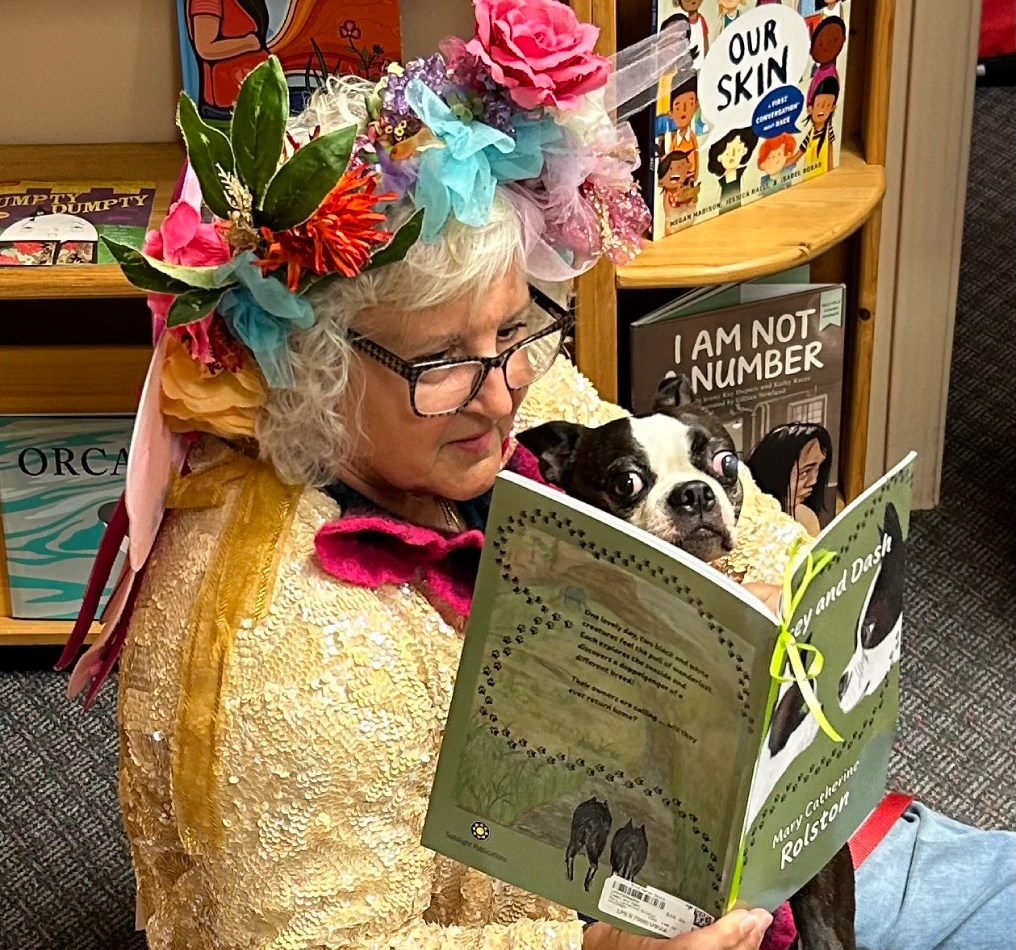

The single most important homework a parent can do with their child—across all grade levels—is reading aloud nightly. The second-best homework activity is for families to write stories together.
—Fairy Dazzle
During my 24 years as an elementary school teacher, I became known to students and their families as Fairy Dazzle. This alter ego was one of the characters that my colleague, Leslie Bell, and I developed as leaders of our school’s social-skills programming. In costume, we led school assemblies.
While teaching, I also wrote children’s stories, and I transferred my persona as Dazzle into a side business, Joie De Vivre, with my retired business-executive father, Frank Urbanski, a.k.a. Sparkle. We developed and delivered fun workshops around corporate team building and employee recognition celebrations. I wrote a business parable, The Executive Gardener and The Fairy, including seven of my father’s business stories.

After retirement, I was determined to continue supporting family literacy as Fairy Dazzle. I made it my mission to self-publish my children’s stories into vocabulary-rich, alliterative, often rhyming, read-out-loud picture books aimed at kids from ages five to 11.
As an educator, I knew that the best way to get kids to stretch and get exposed to more difficult, complex vocabulary is through stories that are playfully alliterative and can be acted out. Another gentle way to teach new words is to have the adult reading the “difficult” text to the listener.
“Read to your child; do NOT push them to read.”
I published my first children’s book, In Search of Something Green, in 2017, and my twentieth book, Eekhorn Furry Dude, will be out in December 2025.After my fourth book was published, COVID hit, and, like everyone, I was stunned by the shock of the global pandemic. To help educators and parents, I started a blog filled with activities, lessons, and long-range plans, plus specific reading and writing strategies. Today, my website boasts over 300 blog posts and my YouTube channel includes Fairy Dazzle readings.
My mission continues nationally. In October I was an exhibitor at Telling Tales, Canada’s largest literacy festival, with an attendance of over 20,000 across two days. I shared my message with hundreds of parents and children.

Here are my suggestions to families to help support reading and writing.
- Carve out 15 to 20 minutes a day to snuggle up and read to your children. Choose the best time for your family. Aim for five days a week, if not seven.
- Read to your child; do NOT push them to read. If they offer, great, but otherwise, this is a time where they can sit back and relax, enjoying your voice, the story, and the illustrations (if you’re reading a picture book).
- Have fun and let your inner drama king or queen loose. Encourage your child to chime in or act out different scenes or character reactions.
- Quickly and simply share definitions of new and difficult words, then move on. Before you start a story, introduce a new “tough” word and ask your child to listen for it. When they hear it, they might make a comical sound, toss a stuffie in the air, or react in some other fun and playful way.
- Before reading the text, do a brief picture walk through the book and ask your child to predict what they think the story is about
- Start using PRCs (predictions, reflections, and/or connections). This is done through simple, casual questioning. Prediction: What word might follow in a rhyming couplet text, or what action or reaction might happen next? Reflection: Ask your listener to share their understanding of the text and invite them to provide a retelling. Connection: Ask the child to connect the story to their own life experiences and knowledge. When engaging in PRC questions, don’t overdo it; be relaxed and follow the interest of your child.
- After reading, consider doing research with your child on the animals, setting, or other topics related to the story.
- Allow the story to be an inspiration for you or your listener to tell their own story. Maybe they might want to write their own version of a story.
- Write a story together. Invite your listener to tell a story while you take dictation or record their telling on your device, then print it so they can illustrate it. Be careful not to drive or over-manage the story. It’s okay to gently support editing by correcting verb tenses and adding description and details, but be sure the story remains authentic to the child’s skill and interests.
- Tell your own version of a classic fairy tale, like The Three Little Pigs, or make up a story. Ask your listeners for input to make it a collaborative story.
Snuggle-up-and-read time is a priority that’s fun and reaps huge benefits. Not only does it support academic success, but it encourages relaxed, non-threatening communication with your child. In addition, it has the potential to inspire the telling and writing of stories— individually or collaboratively. You never know where this powerful sharing of story may lead.