A banana slug’s journey under the full moon becomes an intimate portrait of survival and connection in our coastal forests.
The full globe of the moon is a luscious puffball mushroom, suspended over the pinnacles of swaying cedar trees. Cradled in the branches, its round face glistens as if daubed with dew. Along the boundary between forest and sky, ephemeral moon-rays outline black needles with silver highlights.
To the moon, floating high above the forest—there is where I must go. I yearn to feast upon it. An impossible task for a little banana slug, perhaps, but I find myself driven by an impulse deeper than reason or fear.
In recent memory, I baked in the heat of summer afternoons and curled into a tight ball under crisp fern fronds as my entire body ached. When evening brought cooler temperatures, I sought the low spaces where moisture collects, but the earth was too dry and no dew appeared. My green-yellow skin threatened to crack. My single foot burned on the sun-seared earth. Mushrooms wizened into husks—there was hardly a morsel worth eating. I feared I’d shrivel up, too, into a little grey knot peppered with black dots.
When finally a scant fog arrived, the moss perked up and the witch’s butter returned. Relief flooded my poor bruised heart. I ate my fill and then some! My skin grew supple again, and I stretched and swelled, flexed my limber foot. Then the first rains fell, trickling down through the speckled leaves and tiny twigs, coalescing into rejuvenating drops that tasted sweet. Silky mud returned. The heat of summer relented. Cool autumn revived.
For days, I munched on slippery jacks and fly agarics. I nibbled on lichens and lungwort. I delighted in deer droppings and wind-fallen salmonberries, felted with white mould. I found satisfaction in the raspy crunch against my radula as I scraped nutrition from the bountiful forest floor.
And then, the full moon took flight.
Has anything ever looked so dazzling?
It rises in the east like a bolete cap swelling out of the soil. Mesmerized, I can barely tear my gaze away. It weaves through the upper canopy, hiding and peeking down at me, calling out through the breeze like a whispered, half-forgotten melody.
I set my foot upon the bark of a hemlock tree. What does the moon taste like? Is it musky, like a fresh chanterelle? Or does it have the rotting tang of an old oyster mushroom? The tree is as rough as sand under my foot, but once the bark’s surface is softened with slime, the fringe of my skirt dances over the blessed imperfections, and clinging thusly, I climb.
Inch by inch, I rise above the forest floor. Soon I’m higher than the tops of the sword ferns and spindly huckleberry sprigs. Delicious scents envelop me. Is this the fragrance of the cosmos, sweeping down to encourage me? The moon continues its transit over the trees, then starts a graceful descent into the west. My path takes me out along a twisting branch, where the surface is already blunted by a silvery trail of slime that tastes as familiar to me as the inside of my own cheek.
A friendly form waits near the tip of the tree limb. The body is stout, strong, and stalwart, covered with glossy yellow skin and patterned with comely black spots. The mantle is shapely, unblemished, and beautiful. Another pair of translucent eyestalks stretches toward the hypnotic moon, drawn by its sublime grace, just as I have been.
Side by side, we watch the sky in mutual admiration. Our mantles delicately touch, offering friendship in the midst of a lonely autumn night.
The moon makes us giddy. Slowly, we begin to dance. It is a silent waltz of two sinewy bodies, spiralling around each other, tasting each other’s intentions with our sensitive feet. Skirts flicker like kisses. The beautiful moon is forgotten under a barrage of radulae nips—nothing so violent as to injure, of course, but just enough to thrill. Soon, flower structures as pale as ghost pipes emerge, slipping into each other’s gonopores to deposit bodily gifts, deep within the spermatheca.
The moon sinks and, in satisfaction, so do we.
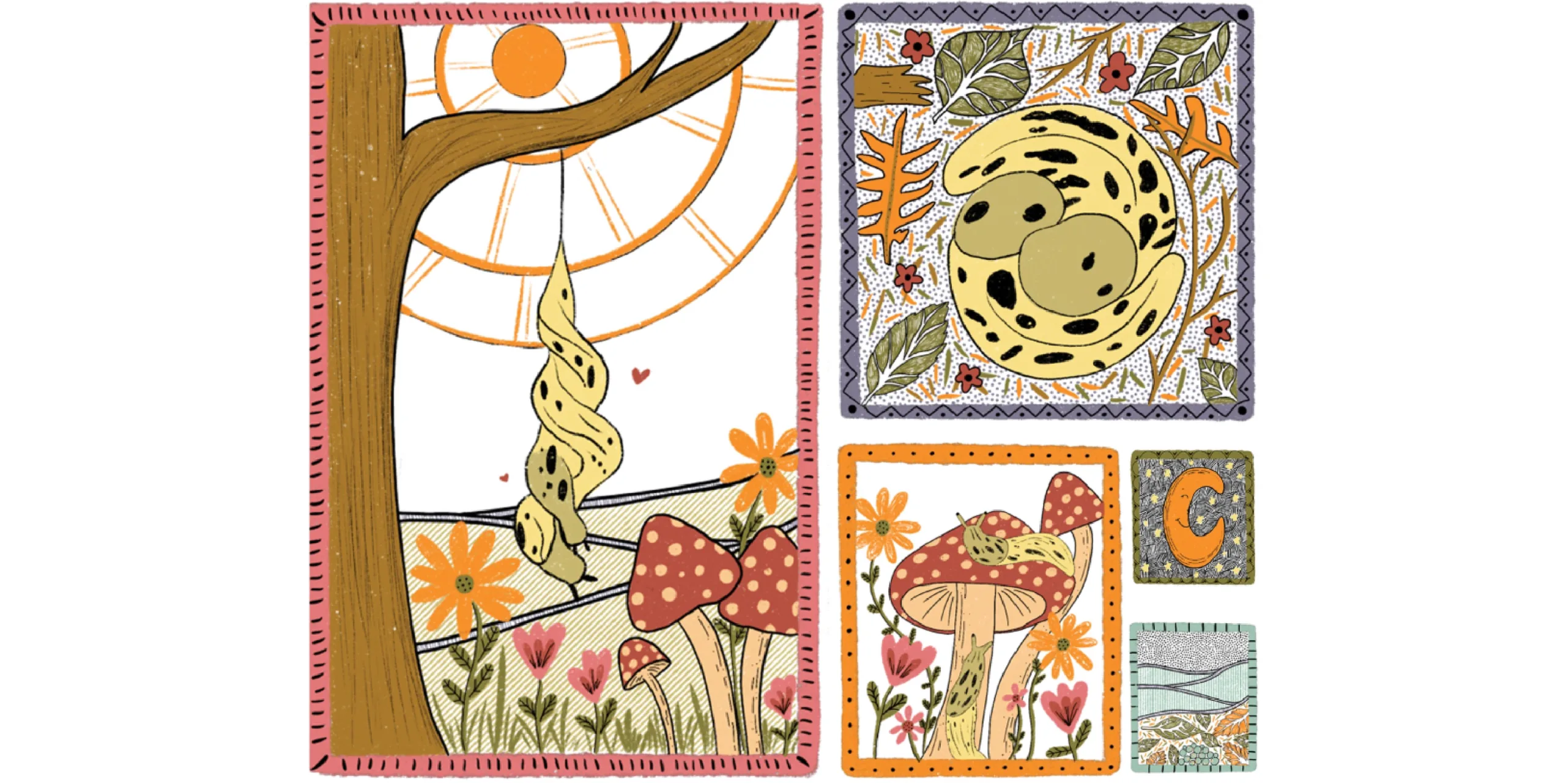
Our dance has manifested a froth of slime, and, safely encapsulated within this glistening bolus, we slip around the side of the branch and begin to dangle. Like all our motions, our descent is slow and controlled. We sink on a linguini string of thick mucus until, after only a few heartbeats, we hang above the forest floor in a passionate embrace. Like the moon, we are swaying in a black sky; our joining has transformed us into a cosmic orb of black and yellow, gleaming with moisture and starlight, and revolving slightly with each muscular contraction. We remain untouched by dirt, tree, gravity, or concern. We exist outside of time, suspended in darkness.
Too soon, the moon sets.
Exhaustion overtakes us. Our chemical conversation of scent and slime finds agreement in parting, and we disentangle, breaking that linguini string and letting gravity claim us. The fall is not far enough to injure, but as our embrace cracks apart, the impact knocks a little sensation back into my boneless body. The forest floor feels hard and lonely under my aching foot.
The scent of a nearby mushroom promises a satisfying meal, if I choose to follow it down to the trickling spring in the hollow. With precious gifts traded, there’s no further need for companionship, so we part ways, never to cross slime trails again. We both know winter is coming. When cold temperatures arrive, we will abandon our cares for mushrooms or moons: we are destined to return to that existence outside of time, afloat in comfortable darkness.
But under the snow, my eggs will lie protected by a blanket of rotting leaves, and at the first blush of spring, the fruits of our slow moon dance will emerge, hungry and eager to live.