

When Marilyn Harvey-Heinz stood up and asked a question at a packed Qualicum Beach Newcomer’s Club meeting, she couldn’t have imagined how profoundly this moment would affect the next several years of her life.
“I put up my hand and stood up and said, ‘How many people in the room have a doctor here?’” she remembers. “And I don’t know — five people put up their hands.” She was incredulous.
In the Oceanside area, roughly 9,000 residents lack regular access to a family doctor or basic healthcare services, with a projected need of 20 to 30 doctors in the next three to five years due to retirement and population growth.
Harvey-Heinz has an extensive marketing background, with more than 45 years of experience in luxury resorts and urban retail. This includes her role as the general manager for retail at Fairmont hotels and resorts across North America, Europe, and Mexico. She has also worked with the MacMillan Health Organization in London, UK, to create inclusive fundraising models.
Newcomers with the right expertise
Within a month of raising her hand at the Newcomer’s Club meeting, a group formed to discuss the local healthcare situation. That’s where she met fellow Newcomer, Lynn Bury.
Bury’s background, as luck would have it, is in recruiting and retaining physicians. She worked in rural and northern Ontario creating policy papers that supported small communities in this endeavour. Bury played a key role in developing Ontario’s first physician job board and successfully led the recruitment of over 400 physicians from the United States in varying stages of their education or practice, to underserved areas across that province.
“For me it was personal. I didn’t have a physician, and using my background, I felt that I could contribute and give back to this new community that I was now a part of”
Bury says it’s important that access to healthcare is based on need, not the ability to pay. With the increase of private healthcare clinics, she felt compelled to get involved, using her background and expertise to benefit the community.
“For me it was personal,” she explains. “I didn’t have a physician, and using my background, I felt that I could contribute and give back to this new community that I was now a part of.”
As the small group began looking into the issues in the community, Susanne Cunningham’s name kept coming up as someone they needed to meet.
With Cunningham’s knowledge of healthcare and her extensive background in hospital-based acute care, she brought invaluable insights to the group. She has over four decades of progressive leadership in nursing and perioperative services and has held senior executive roles across major academic and community medical centres in Canada and the United States.
Cunningham was familiar with the issues surrounding healthcare, and she knew that space was a critical piece of the puzzle. “Physicians and nurse practitioners like to work in a clinic where they have interdisciplinary care, to be able to consult and work together as a group,” she explains.
This issue was deeply personal for her as well, as her parents lived in the area and both died without a family physician. This fuelled her passion to make sure that residents have equal access to care.

The three women teamed up, adopting the name Mid Island Health Alliance (MIHA). They conducted thorough research “leaving no stone unturned,” according to Harvey-Heinz. They travelled to meet with communities that had seen success in this area and arranged countless meetings with local leaders and healthcare professionals.
“Not only did we investigate CHC’s [Community Health Centres], but we also tried to understand the government—local, provincial, and federal—and what is doable,” Bury explains. “We wanted to put something together that was sustainable.”
After determining there would be no financial support from the government, they shifted their focus to community philanthropy. Constructive meetings with Fair Care Alliance and the Nanaimo Hospital Foundation suggested that partnering with these organizations would be beneficial.
A new medical clinic for Qualicum Beach
By Dec. 1, 2024, they had formalized their alliance and decided to work together to carve their path forward. By Springtime 2025, MIHA was presented with a potential space for a medical centre.
The space [the old Bank of Montreal in Qualicum Beach] was an opportunity to begin providing residents with the healthcare they needed. The facility would be called Primrose Medical Centre. With heightened excitement, they began brainstorming ways to fundraise.
Soon after, they were invited to a Nanaimo Hospital Foundation fundraiser in Qualicum Beach. During that meeting, MIHA’s goals to improve primary health care in Oceanside were shared.
“And then four or five days later, Susanne gets a note saying that someone had gifted half a million dollars in our name!” Harvey-Heinz recalls. The money was earmarked for MIHA and the old BMO space on Primrose Street.
“We had a paddle on each table, and the idea behind this was, we want everyone to paddle together, in the same direction”
Recruiting and keeping family doctors
From the very beginning, a major priority was recruiting and retaining physicians, Bury explains. One of the ongoing challenges was getting everyone to work together to bring this goal to fruition. So, in September 2025, they brought stakeholders together to present their vision.
“We had a paddle on each table, and the idea behind this was, we want everyone to paddle together, in the same direction,” says Bury.
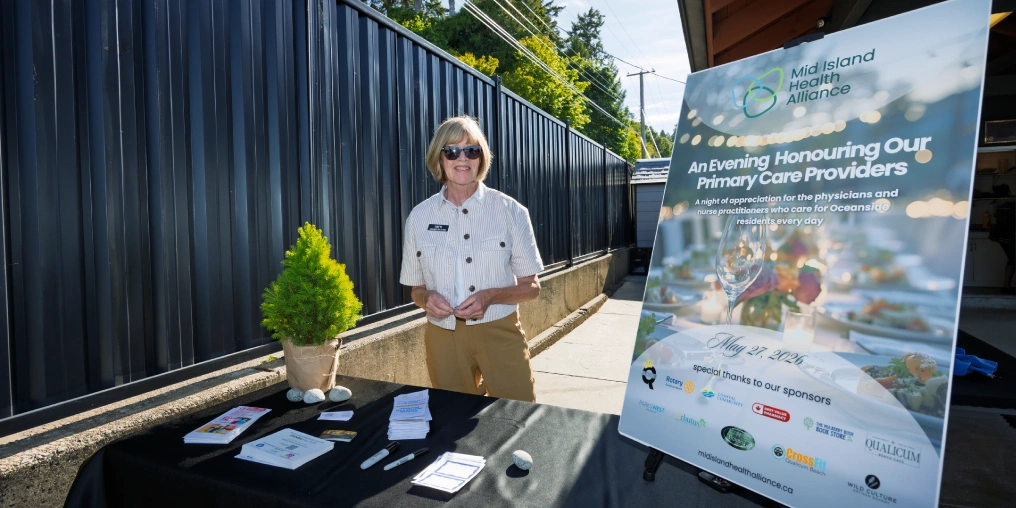
By December 2025, MIHA had set up a recruitment and retention committee. One of their initial projects was to host an evening to honour local primary care providers. The event was a wonderful success, Bury explains, and an important part of retention efforts.

To date, four physicians have been recruited for the clinic, with a goal of nine, having the ability to accommodate up to 9,000 patients over time. Twelve specialists are also targeted for the centre.
Primrose Medical Centre was also in need of a lead physician, and fortunately, they found exactly who they were looking for in Dr. Kelly Hadfield. Cunningham describes her as highly motivated and charismatic, with a compelling vision for the clinic. The clinic will offer interdisciplinary care, allowing doctors to practice the way they want, promoting work-life balance, and avoiding burnout. This is also key in recruitment, Bury explains.
Hadfield will serve as the medical director at Primrose Medical Centre while continuing her leadership roles at the Qualicum Beach Medical Clinic and the Qualicum First Nation Medical Walk-In Clinic.
Working toward the $1.3 million goal
Everything was coming together, but more funding was needed to get Primrose Medical Centre off the ground. Not knowing many local people, they were given lists of potential donors and started cold-calling and meeting with people. They also hosted a cocktail fundraiser, gave presentations in the community, and set up displays at various events to garner support. In July of this year, they presented to 100 Women Who Care Oceanside and were awarded $38,000.
So far, MIHA has raised about $900,000. Construction for the clinic began in July 2026. With a targeted fall opening, MIHA is aiming to raise a total of $1.3 million to complete construction, equip exam rooms, and support physician recruitment. The three women are optimistic they will reach this goal and eagerly anticipate the clinic’s opening day.
As Bury reflects on their journey over the past two and a half years, she expresses her pride in everything they have accomplished in such a short time.
Harvey-Heinz adds that never taking no for an answer and building important relationships were keys to their success.
“And when we open this clinic, and we have new doctors and patients who will have access to a primary care doctor, that will be our proudest moment,” says Cunningham, as the other women nod in agreement.
What started as a handful of newcomers wondering how to find a family doctor became a community-wide effort to improve healthcare in Oceanside. These three women chose not only to make this community their home, but to help make it healthier for everyone who calls it home.