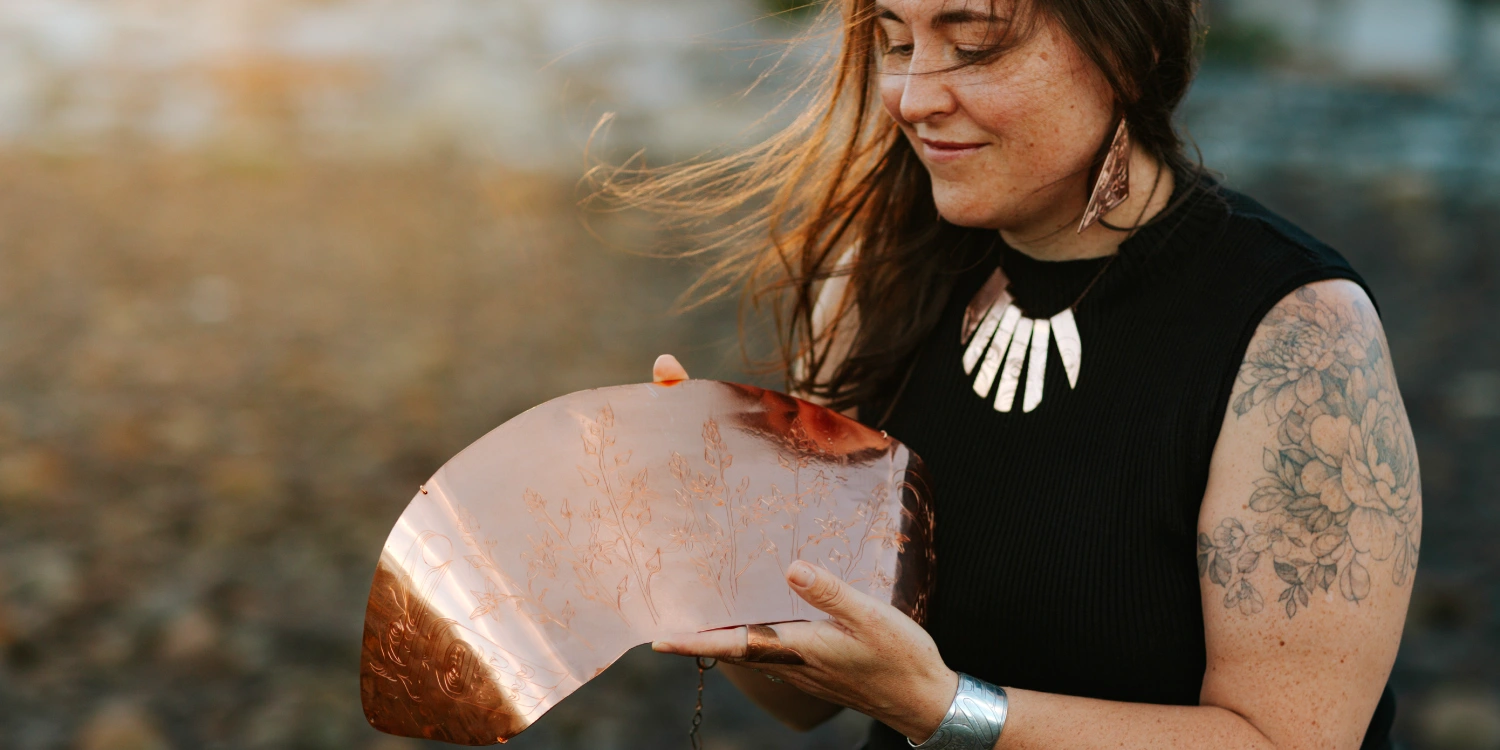
Seaweed Wisden’s parents met in Alert Bay. Her mother, a social worker, had immigrated to Canada from Brighton, England as a teenager, and her father, the well-known Kwakwaka’wakw silversmith carver Norman Seaweed, was born there. The family later moved to the Comox Valley so her mum could take a faculty position at North Island College.
Seaweed Wisden, who is from the Ma’a̱mtagila and Ławitʼsis tribes, has recently made a name for herself as a carver, but she was a teacher long before that. While pursuing her Bachelor of Fine Arts in Critical and Cultural Practice at Emily Carr University, she was part of a program called Growing Chefs, where she helped teach youth and kids to grow food and how to cook.
Then she became a kayak guide for a few years and taught guests about her Kwakwaka’wakw culture, leadership, and the land’s medicines. The kayak guide gig then led to a position as a cultural teacher visiting K-12 classrooms throughout the Comox Valley.
“I see my artwork not as a continuation of myself, but as a collaborative project I get to do with my ancestors and anyone who is part of our community”
Learning to engrave from father and uncle
Her carving career had a start she playfully describes as “accidental.” In 2018, Seaweed Wisden moved to Victoria to begin the Master of Arts in Indigenous Governance program she had enrolled in at the University of Victoria. When the program closed before she could start, she began learning how to engrave from her father, Norman, and her uncle, Alfred Seaweed, another accomplished carver. She discovered a passion for working with silver and copper and began making earrings, bracelets, rings, and necklaces.
When she launched her business in 2018, she named it Sea Wisdom Design. “It’s a combination of my mother’s last name, Wisden—back in England, it was originally Wisdom until it was changed in the 14th century—and Seaweed for my dad’s last name. It’s also a play on words: “Sea Wisdom/See Wisdom, like the ocean has wisdom we can carry,” she explains.
“My work is deeply informed by the traditional art and culture I was raised in,” she says. At the same time, she adds, “I see my artwork not as a continuation of myself, but as a collaborative project I get to do with my ancestors and anyone who is part of our community. The work is Kwakwaka’wakw art, and I am just a small part of that long, rich history.
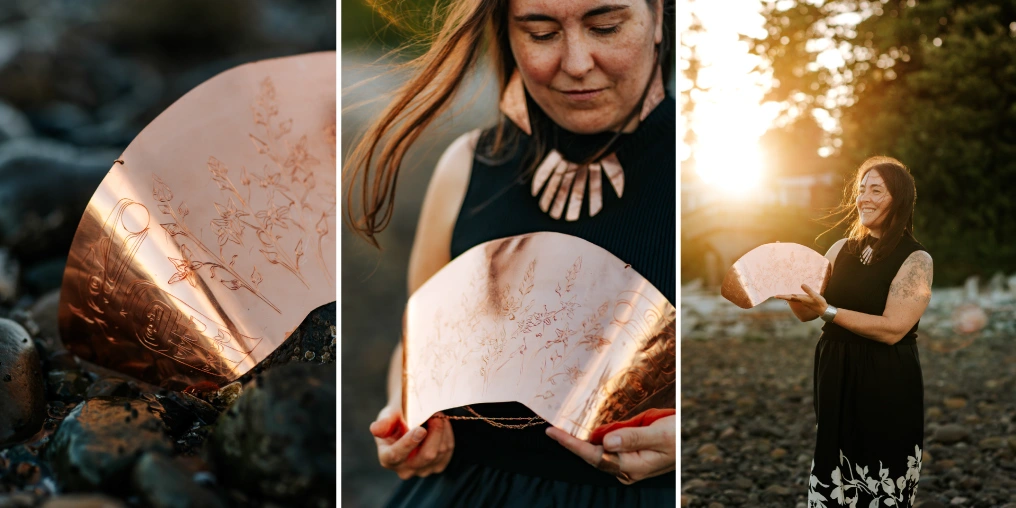
Seaweed Wisden is proud that the artwork that connects to her ancestors has been on the red carpet at some major events. In 2024, “Lily Gladstone was on the Emmys stage, handing Jodie Foster an award, wearing the chest plate, cuff, and ring I made for her. And more recently, Dallas Goldtooth wore one of my copper dancer necklaces at the Fallout 2 season premiere.”
A new chapter at Fireweed
She had already been moving Sea Wisdom away from smaller jewellery pieces toward more couture work and custom orders when a new opportunity came her way: a role as Program Manager for The Fireweed Institute, a non-profit supporting Indigenous business and innovation.
It was a natural fit for Seaweed Wisden, who minored in Social Practice and Community Engagement at Emily Carr University, and who has personal experience as a successful Indigenous entrepreneur. On her Instagram page, she posted: “This work lights me up in a whole new way—it’s about building programs, nurturing big ideas, and helping bring projects to life that make a real impact.”
She won’t stop making metal art, however: “My energy will be going into larger, more intentional art and jewelry projects that need time, resources, and space to bloom.”
“I feel like the work I get to do in my life, both for the Fireweed Institute and my artwork, is a culmination of my ancestral path and passions”
Now almost a year into her work with Fireweed, she is deeply involved in the Fireweed Venture Accelerator Program, a year-long program that helps prepare Indigenous founders (entrepreneurs building community-rooted businesses) for scalable investment or export readiness.
“We are all mostly Indigenous at Fireweed, and a lot of the programming we are creating is made with a ‘for us, by us’ mindset, which is very motivating,” she says. “I feel like the work I get to do in my life, both for the Fireweed Institute and my artwork, is a culmination of my ancestral path and passions. Like these are the steps I take to become a strong Elder for the future.”
Family, culture, and what comes next
While leadership is Seaweed Wisden’s professional priority for the moment, art and teaching are still very much in her life—as is her family.
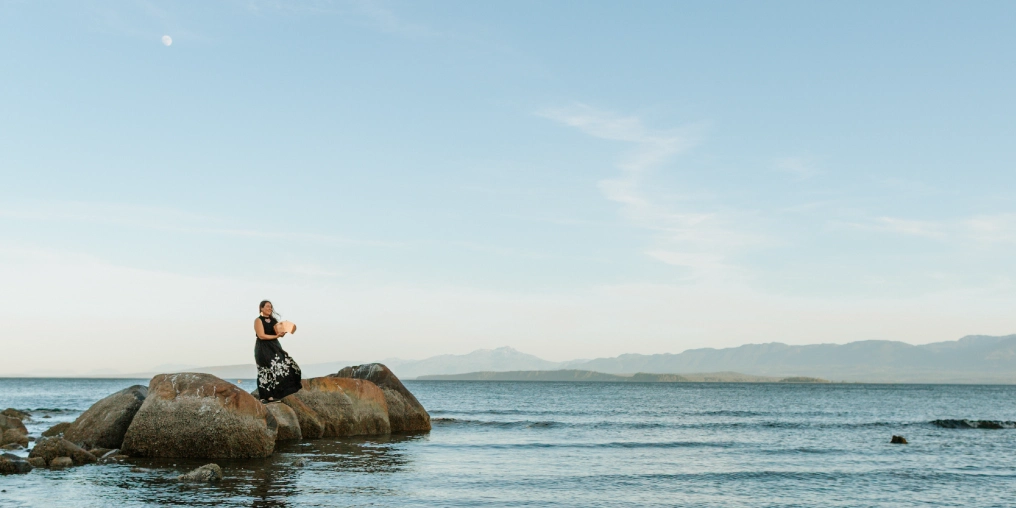
“My family is very supportive, and we collectively believe in care as strength,” she says. “I am very fulfilled by my niblings* at this moment in my life. Showing up for them is how we know our path is safe. And to build strong kids, they always need more people around who want the best for them.” Some recent family milestones include her father being named one of the Chiefs in their Ma’a̱mtagila clan, and some of her nieces receiving their traditional names in a coming-of-age ceremony.
*Nibling: a gender-neutral way to refer to one’s siblings’ children.
As for the Fireweed Institute, Seaweed Wisden says, “It feels like a calling, and I love the balance of giving back while having received so much in my life.” It’s creativity of a different kind from her metal art, but informed by the same cultural values and strengths. “Coming from an Indigenous background, the way we relate is always through story, so I see that as a big part of my time there—co-creating this transformative story where we are reimagining and implementing a fairer world.”