
With no previous experience creating board games, we had a lot to learn, and a long way to go.
When I first suggested it to my wife, Anne, who had never played hockey, she encouraged me to draw my idea on paper. After I did so, we started playing, and, eventually, we outgrew the paper versions. Anne used her graphic design skills to input the game into a computer, and Dice Hockey® Challenge! was born.
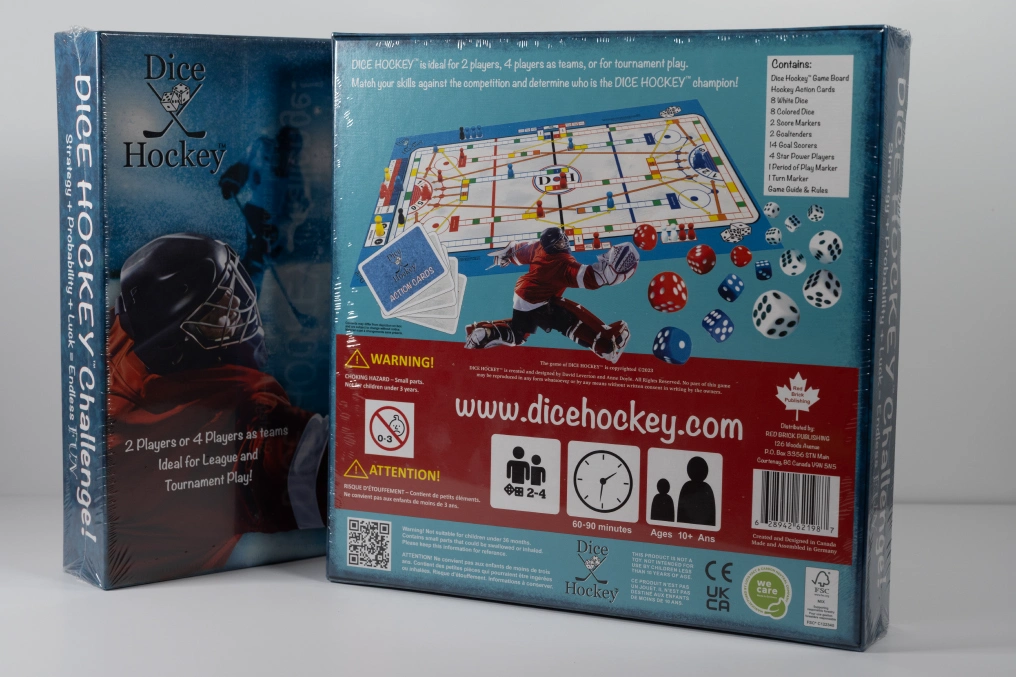
Well, our first prototype was born.With no previous experience creating board games, we had a lot to learn, and a long way to go. After registering the trademark for Dice Hockey®, we began sharing our prototype with play testers. Then, over the next year, we continued to refine the game by playing it repeatedly—often with our next-door neighbour, Herb. We had plenty of fun trying out new ideas and testing different hockey action cards.
We refer to Dice Hockey® as armchair hockey at its best.
Early on, we realized the importance of aesthetics. Anne had a big hand in designing the layout. We created a six-sided fold-up board, scaled to the size of a regular hockey arena, that could be easily stored in a relatively small box.
How Dice Hockey Challenge works
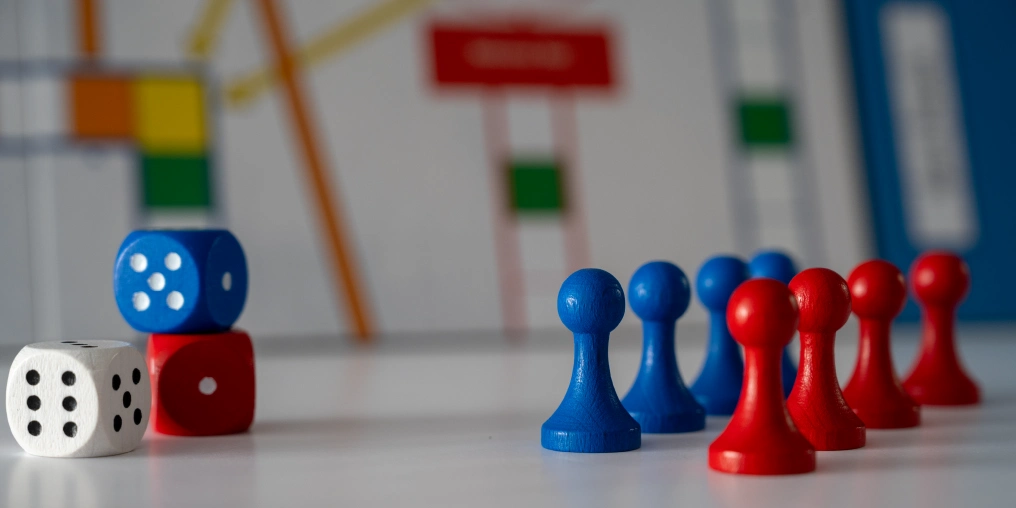
We refer to Dice Hockey® as armchair hockey at its best. (It’s based on strategy, probability, and luck, so you don’t need to understand hockey to enjoy it.) It’s played by two to four people in three roughly 20-minute periods. At the start of each game, two teams of hockey players are set up on the board. In case there’s a tie after three periods, each team gets five extra turns, and then, if necessary, there’s a shootout.
Since the first edition of Dice Hockey® Challenge! arrived in late May 2024, we’ve been marketing and distributing it to locations throughout Canada and have already released our second edition. There’s a basic and advanced (pro) version that includes star players and different offensive and defensive strategies.
Thanks to our loyal followers, Dice Hockey® continues to evolve. And our learning continues, too—we’re already planning other new games.
The benefits of playing board games
Research has shown that games are essential for healthy development in early childhood and beyond. Game play lets children learn new things and practice what they know. It allows them to experiment through trial and error, find solutions to problems, work out strategies, and build confidence.
Board games also encourage children to develop important social skills, such as waiting, taking turns, sharing, losing and winning gracefully, making conversation, solving problems, compromising, collaborating, and being flexible.
Experiential learning in a fun and engaging way is great for people of any age, since it supports the principle of critical thinking, which is an important life skill. And board games are great for reducing stress and increasing laughter.