
There are several ways to get to Santiago; the most popular one starts in France and traverses the Pyrenees in a westerly direction. The second most popular route heads north through Portugal, starting either in Lisbon or Oporto. Every year, 200,000 people do the Camino Portugues. In 2024, Sue Wheeler and I were among them.
Starting our journey in Viana do Castelo

We started our Camino a few kilometres north of Oporto in the beautiful seaside town of Viana do Castelo. To receive the compostela (certificate of completion) at the end of your hike, you must walk a minimum of 100 kilometres. We planned to walk twice that.
We used a QR code to register ourselves as official pilgrims and then needed to get our (pilgrim passport) stamped along the way, showing the date, to prove that we were actually walking. This is a holdover from the 13th century, when there were not only religious pilgrims doing the Camino, but criminals. The latter were assigned pilgrimages as a penance, and the certificate proved they had finished the journey. Churches, tourist information centres, police stations, restaurants, coffee shops, hotels, hostels, and many stores along the way are happy to stamp your passport.
Preparation for the Camino Portugues
There wasn’t a lot of planning or training for this trip. It was a last-minute impulse. Before we left, we did a few 14-kilometre hikes around the Comox Valley to get an idea of how many hours a day we would walk. We also joined a Camino Facebook group for travel tips: where to buy walking poles, e-sim versus actual international sim cards, the best train-travel apps, bathroom availability, language difficulties (if any), and places of interest.
We booked a self-directed tour package where our luggage transfers, accommodation, and some meals were arranged. This meant we only had to carry daypacks and didn’t have to deal with feeding ourselves after long days on the road. Our daily mileage was ambitious but reasonable—anywhere from 14 to 21 kilometres. The disadvantage was that there would be no rest days. Every day would be a walking day, rain or shine.
Navigation challenges
With our white hair, Sue and I are what her son Jesse calls Q-tips, and we were on the older end of the age spectrum on the Camino. Our combined age is over 135, but we’re in reasonable shape and are used to walking the uneven trails around Cumberland. What we didn’t realize, never having travelled together, is that we are both directionally challenged.
In the rural areas, we could use the yellow shell markers found every kilometre, or so, to guide us. (Scallop shells are an emblem of the Camino.) Getting out of the towns and cities was a bit more problematic. We relied on paper maps provided by helpful hotel reception staff, and if we got turned around (which happened frequently), we scouted around for other pilgrims—we called them Caminos—to follow. They were not numerous until the 100-kilometre mark, but they were easy enough to spot thanks to their backpacks, shells, and walking sticks. Somehow we lurched our way along, keeping pace with the younger pilgrims and surpassing them on the long, uneven, steeply inclined Roman roads. We are used to elevation gain!

The sights and sounds of northern Spain and Portugal
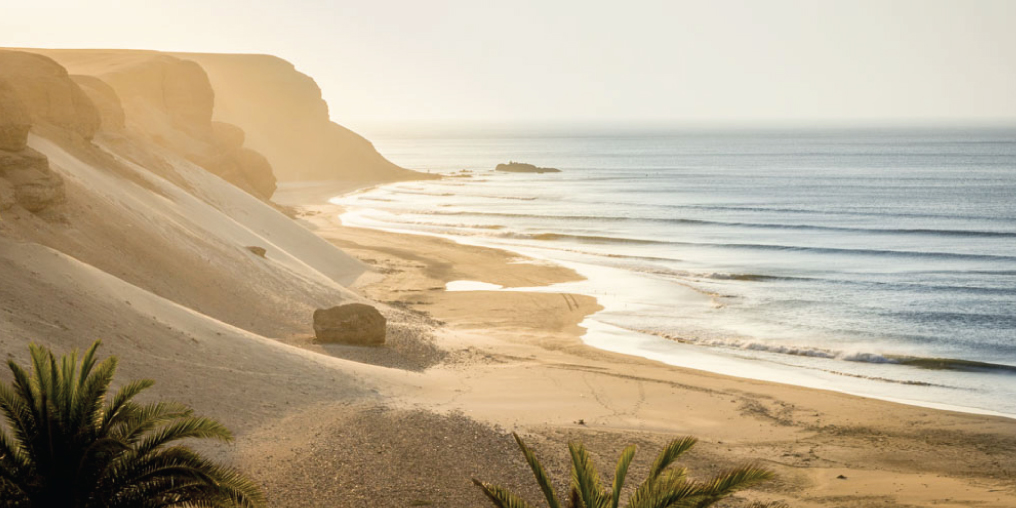
We saw only one small sprinkle of rain in eleven days. We started walking early and finished most days by two o’clock, keeping a steady pace, with an occasional stop to admire the view or some local feature. I couldn’t get enough of the surroundings—the Atlantic Ocean, old Roman marine salt beds, stone pillars in vineyards, ancient cobbled roads worn down in the middle, Galician hórreos (traditional raised granaries), and beautiful public murals everywhere. Wildflowers, familiar, yet giant. Chickens, cats, horses, and goats. When we walked on city streets, or along the highway, everyone honked and waved, wishing us a bon camino.
The food was delicious. Padron peppers, razor clams, giant sardines, octopus, Portuguese tarts, and Galician cheesecake were washed down with vinho verde and vats of cafe con leche.
By day nine we were starting to flag. It was getting hot. Tensor bandages came out and our handy store of painkillers made frequent appearances. We put more weight on the walking poles as our calf muscles bulged and spasmed, protesting the relentless pace.
Arriving in Santiago de Compostela
The day we arrived in Santiago, almost 3,000 weary peregrinos trickled into the city from many directions, ending at the cathedral square and greeted by the sound of traditional Galician bagpipes and given our compostelas (written in Latin). Mine read: Dominam Auroram (Lady Dawn) Copeman.
Sue and I felt every one of the 220 kilometres we’d walked, but we couldn’t stop smiling. One off the bucket list!.