A hotel built for a coal town
It was a time when fresh bread was delivered by horse-drawn carriage. Cumberland was still called Union. Coal reigned king. Eager workers came from all over the globe to make their fortunes. (Most would not.)
Victor Bonora was an Italian wrestler and boxer who had lived in Cumberland since 1893, working the mines and making plans for a community gathering space that would serve those travelling to and from the coal centre.
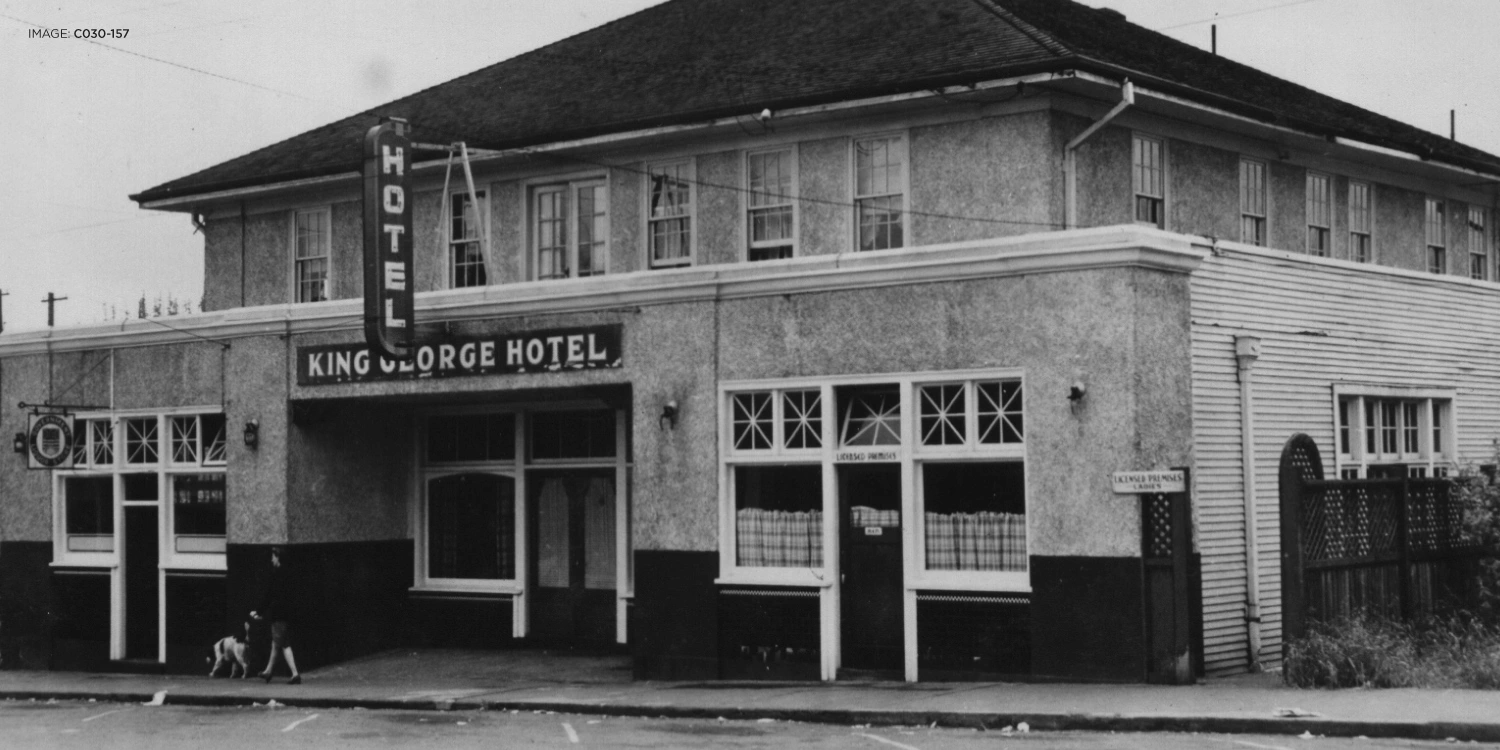
When Bonora first opened the King George Hotel in 1909, newspaper ads boasted it was “first class in every sense,” with a staggering 50 hotel rooms. It was “heated throughout with hot air” and even featured a solarium and a classy bar that served some of the best cuisine in town. The ads promised “special attention to transient guests” and spoke of splendid trout fishing.
It’s hard to explain to new Cumberlanders the role the King George played in the community. It was the Cheers of Dodge City; regulars had their own spots at the bar
Like most buildings on Dunsmuir at the time, the King George had an imposing façade and wood construction—and it was soaked in booze. It would remain at the centre of Cumberland culturally, socially, and geographically, until it closed in 2014.
It’s hard to explain to new Cumberlanders the role the King George played in the community. It was the Cheers of Dodge City; regulars had their own spots at the bar. Weddings, funerals, and business and political meetings were held here. “The Big Strike” of 1912 would have seen lively debate inside the walls of the hotel not long after its opening. In October 1918, the Spanish influenza pandemic arrived with fury, and the first patients and victims were cared for under the King George Hotel’s roof before eventually being transported to Cumberland Elementary School.
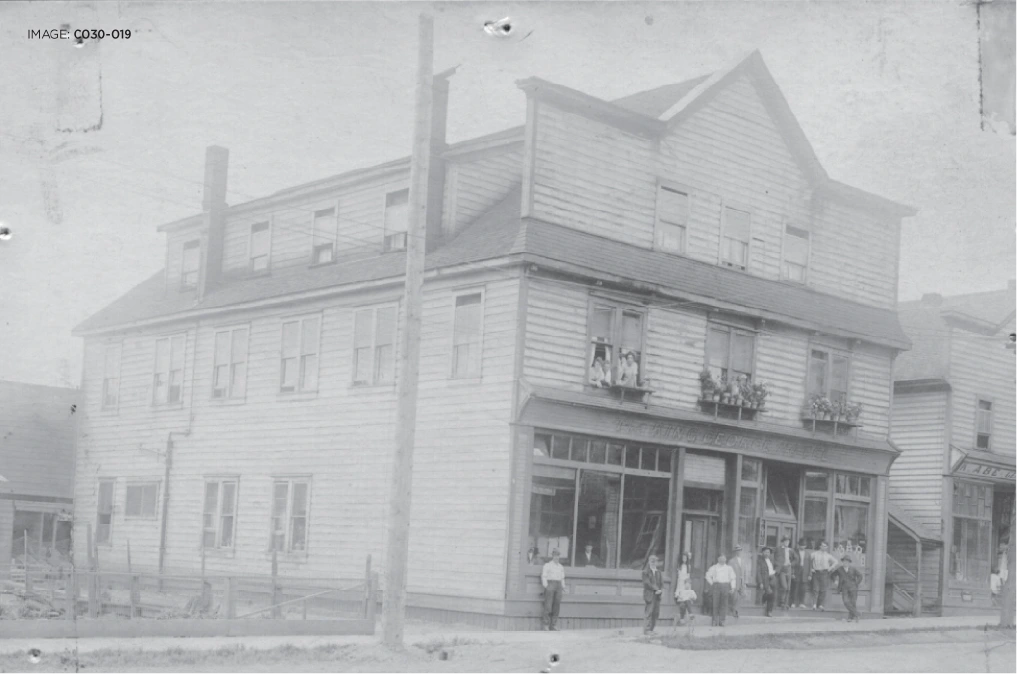
In 1921, the government of British Columbia legalized the sale of alcohol, after less than four years of prohibition. Victor Bonora saw yet another opportunity and rented space to the newly established BC Liquor store. After the return of legal drinking, a strange cultural shift in pub culture was born. In many “beer parlours” across BC, like the King George, gender segregation regulations were implemented. There were now separate entrances for men and women, and separate areas to drink and carouse. However, if a woman arrived with a man, she could sit in the men’s area.
The fire that reshaped Cumberland
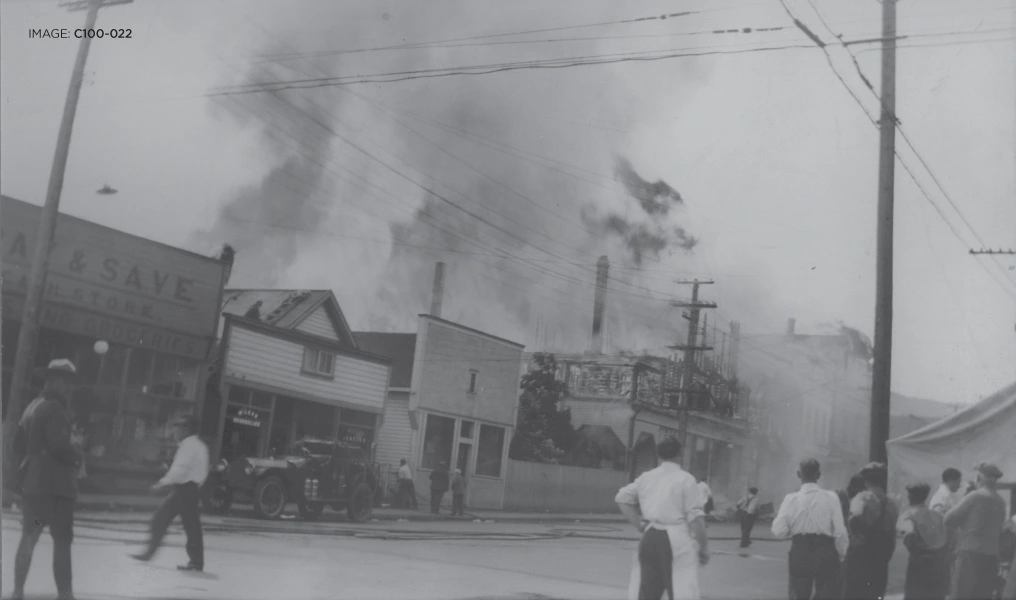
One of the most defining events in Cumberland history is linked to the King George. While it most likely was started by a defective chimney, unconfirmed local lore alleges the disastrous 1933 Cumberland fire was sparked when Carlotta Bonora—Victor Bonora’s first wife—accidentally set fire to the curtains in her private chapel while lighting a candle in tribute to her ex-husband’s recent passing. Two hours later, almost half of Cumberland’s commercial district had been razed by the fire. At least ten houses and 18 commercial buildings were lost before the hard decision was made to create a firebreak by blowing up the Royal Bank. The fire was staunched, but the King George was ashes.
Despite being in the throes of the Depression, within six months Cumberland had mostly rebounded, and there was a new King George Hotel. It was designed by John Graham Johnson, a resident architect with the powerhouse Canadian Pacific Railway who had previously been involved in building both the Banff Springs Hotel and The Empress Hotel in Victoria. It had significantly fewer bedrooms than the original (a total of nine) and a dining room, lounge, kitchen, and offices. Less than a decade later, in 1941, the hotel was sold at auction to Mr. and Mrs. Samuel James McCreery of Victoria for $14,000. In 1945, it then went to Sarah Louise Affleck and Arnold McIntyre Affleck.
The Brown family era
In 1967, a local rivalry with another iconic Cumberland drinking establishment erupted in more flames.
One night in April, two men simultaneously set fires at the back and front of the Waverley Hotel. They fell short of burning it down, but caused extensive damage. Newspapers later reported that a co-owner of the King George Hotel, Leonard Robert Wilson, was charged with two counts of inciting others to commit arson.
“For almost 40 years, it was arguably “the spot” on Dunsmuir”
From 1971 to 2014, the hotel was owned and operated by the Brown family, led by Percy “Brownee” Brown. Pub laws had desegregated their drinking areas, finally allowing single women to drink where they chose. Brown fostered a uniquely small-town community spirit. Under his guidance and after an economically challenging era, the King George reinvigorated itself as a social institution.
For almost 40 years, it was arguably “the spot” on Dunsmuir. However, by 2014, it showed signs of age, with a dark, dingy interior marked by wood and leather that contrasted with the evolving Cumberland eating and drinking scene. The hotel closed in 2014, to the dismay of many longtime locals.
The King George returns
And now, the King George is back. The hotel opened to the public in March of 2026, and the pub should open within the year. The iconic stairway in the lobby remains. Signage from another era has been preserved and showcased. A large archival radiator has been repurposed as the front desk. There’s even a piano from days past in the lobby. The hotel now offers seven rooms that showcase some of the original flooring and features but have been renovated to reflect a modern version of the “first class in every sense” experience Mr. Bonora dreamed of—and brought to life—over 100 years ago.