
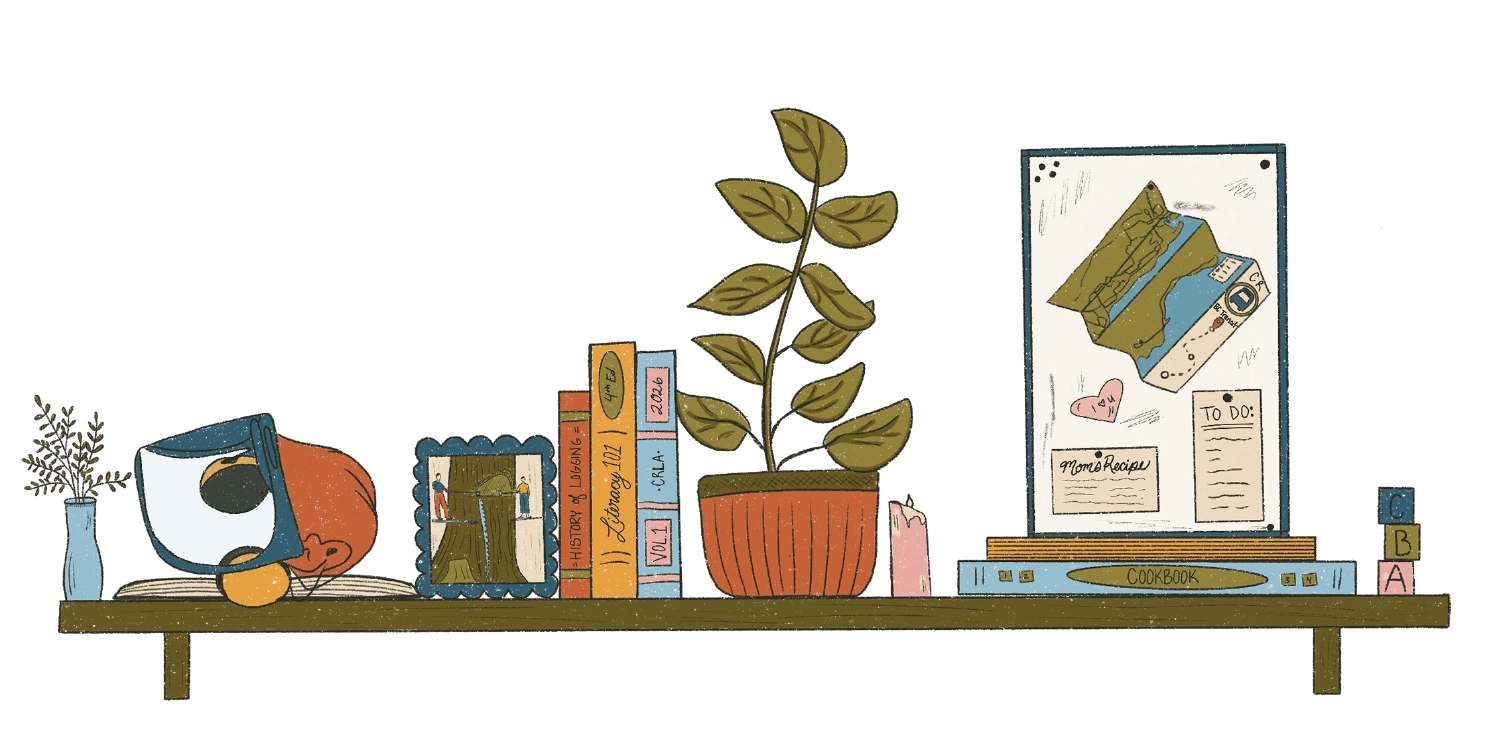
Throughout the twentieth century, North Island communities have adapted to astonishing technological changes—from Morse code to telephone, carbon copies to photocopies and emails.
Between the 1950s and early 2000s, logging in Campbell River transitioned from an industry based primarily on physical labour to one built around the use of heavy equipment. Handsaws began to be replaced by power saws, and fewer workers were needed. Those who were retained were then expected to be able to communicate with paper-based forms, lists, and work orders. As resource-based industries shifted their skill requirements, people who had left school early to participate in lucrative jobs in forestry, fishing, and mining suddenly needed to upgrade their literacy skills.
Not all unemployed workers, however, were prepared to start reading computer screens for their lessons. For some students, the basics of reading—a skill which some had never used—was the starting point.
“One student who rode his bike long distances in all weather was soon able to use the city’s bus system because he could read the street signs and the bus schedule”
Carol Forbes and the early days of literacy coaching
A Campbell River local, Carol Forbes, had recently completed an Adult Dogwood (high school) diploma herself; during her studies, she’d witnessed some of her fellow students’ struggles. When a job was posted for a role to coach basic literacy skills, Forbes was a ready candidate. Her down-to-earth warmth, humour, and never-say-never attitude led her varied group of learners from being resistant, barely basic learners, to becoming lively, literate students. Those who had thought “no way” now saw a way through the web of words.
Literacy changed many of these adult students’ lives immensely. One student who rode his bike long distances in all weather was soon able to use the city’s bus system because he could read the street signs and the bus schedule. After another discovered the local library had cookbooks, she joked that her improved cooking was making her husband get fat! Being able to read the local newspapers allowed learners to cast informed votes at election time and empowered them to participate in the community in new ways.
The CRCLA takes shape
Needs for adult learning were also being addressed all over the province. Forbes connected with people doing similar work in nearby Courtenay, where a non-profit society had been launched to handle the wave of adults seeking support.
She learned the advantages of such a structure and saw how to legitimize the work. In 2002, thanks to Forbes and her school district colleagues, the Campbell River Community Literacy Association (CRCLA) was formed. It became an official entity—eligible for grants, donations, and participation in government programs—and a solid part of the Campbell River School District (SD72).
The 2010 Olympics and a literacy legacy
Not long after, Lower Mainland community development and sports organizations began lobbying the provincial government to pursue the chance to host the 2010 Winter Olympics in Vancouver and Whistler. When they succeeded, a new type of worker was needed who could adapt old skills to new equipment, new projects, and new work settings.
Training programs for workers were created, and funding was assigned. Between 2000 and 2010, according to Olympics.com, “31 new programs were initiated, and others were supported to generate measurable social change in the areas of sports, healthy living, literacy, arts, accessibility and inclusion.” These programs are acknowledged as “one of the most important legacies of the Olympic Winter Games 2010.” Literacy was right there in the middle of the goals and the action!
During this period, Anne Boyd, an active leader and literacy champion within the school district, encouraged the expansion of literacy services throughout the community, accessing a new provincial government funding stream called Literacy Now.
An entity called the Community Adult Literacy Program (CALP) was also designed to embed literacy supports into existing organizations such as the local John Howard Society and the Women’s Resource Centre.
Boyd was invited to participate in a provincial planning group which aimed to individualize literacy programs to meet each community’s unique needs. With engagement from the school district, a community plan was developed for Campbell River, with Boyd as the coordinator for Literacy Now.
The plan included programs for all ages and needs. For example, the Success by Six program enabled preschool parents who thought they did not read well enough to be reading to their children to learn alongside their kids. Also participating in the plan were Campbell River’s Laichwiltach Family Life Society and the Homalco First Nation, both of which hosted learning opportunities and were involved with the Aboriginal Early Learning Network.
Mill closure, newcomers, and new pressures
In 2008, a much-anticipated and anxiety-provoking event occurred in Campbell River when the pulp and paper mill closed. Women became more likely to enter the workforce to supplement the family income.
Several streams of immigrants had also joined the community over the previous two decades; English language skills and literacy were part of the challenges facing newcomers. For some, programs set within the walls of schools and colleges carried intimidation or held memories of little success.
Because budgets to address these concerns were limited, informal settings became learning places. The Community Hall offered Moms and Tots opportunities where parents were introduced to the concept of children learning together with their parents. Afternoon classes within the Homalco community and morning sessions at Laichwiltach Family Life Society introduced Indigenous adults to possibilities for learning in familiar environments.
“The challenges of low literacy aren’t over, and the ways of navigating them will continue to expand and adjust as technologies change”
Time in these settings with supportive, trained literacy volunteers made learning accessible, as did low-cost and subsidized courses through SD72’s Continuing Education for Adults and North Island College.
These varied options for adult learning are still available today, and the CRCLA continues to serve as a vital proponent of local literacy. Its welcoming space in the multi-program Robron Learning Centre functions year-round. The challenges of low literacy aren’t over, and the ways of navigating them will continue to expand and adjust as technologies change.
For more information about literacy programs and supports on the North Island, visit literacyforall.ca or email info@literacyfornow.ca.