From game to gritty reality: Coal mining in 1888
Coal mining more than a hundred years ago was anything but shiny. In 1888, when James Dunsmuir opened the first mine in Union (now Cumberland), there was no magic button you could click. Each piece of coal hewn out of the rock had a man with a pickaxe at the other end, lighting his workplace stall with an open-flame lamp.
In the early slope mines, mules hauled heavy coal carts on rail lines out of the earth to the pit head. After the weight was tallied, large chunks of coal were moved by rail to the deepwater port at Union Bay. There the coal was sorted, crushed, sized, and washed, then dried and loaded onto boats by Chinese trimmers. (The slurry of waste, effluent, and tailings created during the cleaning process was left to leach into the foreshore around the bay and drain directly into the ocean.)
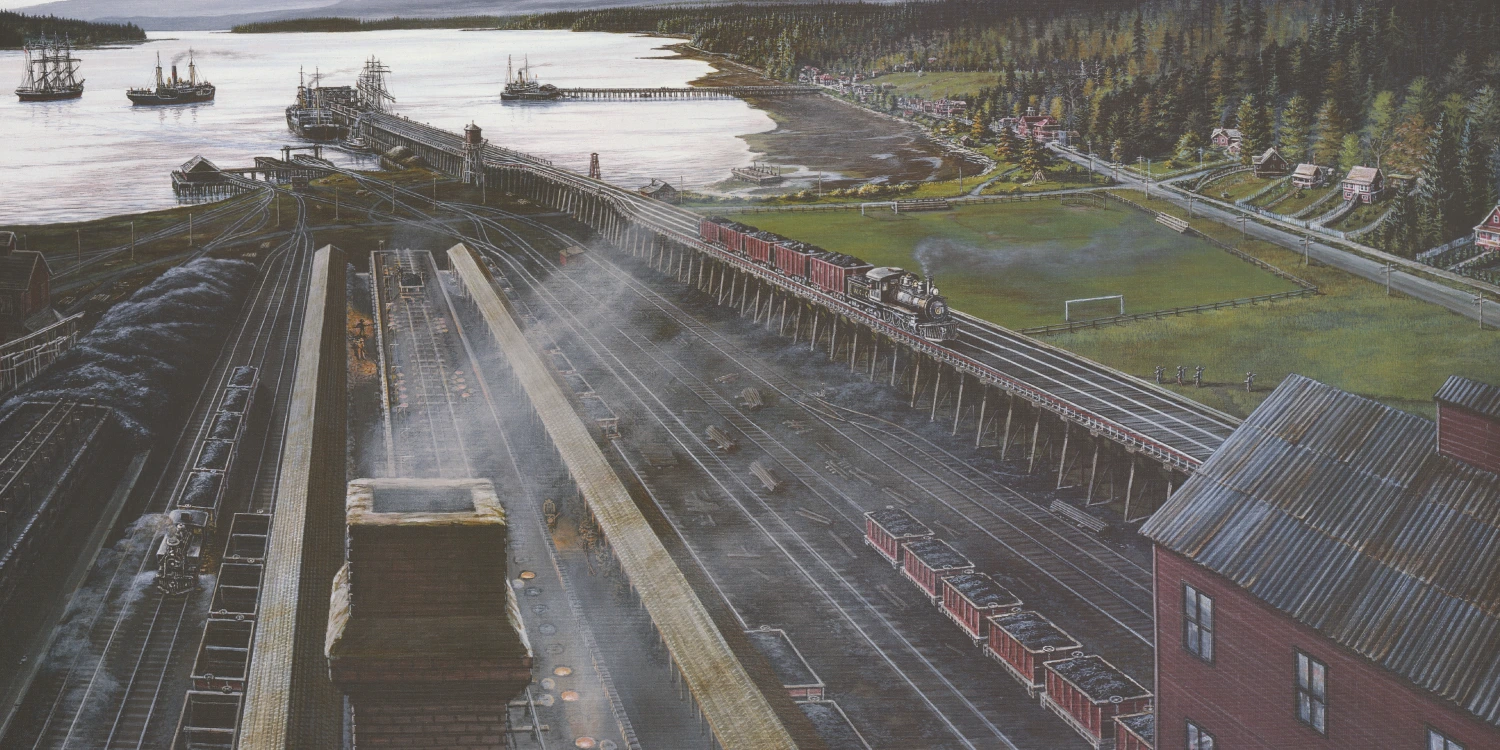
As many as six boats at a time tied up at the wharf, some so large they had to be towed in from the narrow strait. The colliery wharf stood 50 feet tall at low tide.
“Six and a half tons of slack make four tons of coke, which can be sold for five times the price of regular coal.”
Cumberland coal was good bituminous coal, in demand for its high heating value, and the coal barons knew how to use the leftover material to make even more money: they coked it.
All that crushing and washing of the larger pieces of coal created mountains of coal dust and bits (under a centimetre in size, too small to be sold) called slack. Six and a half tons of slack make four tons of coke, which can be sold for five times the price of regular coal. Coke is a slower and cleaner-burning fuel that was used for lead and zinc production.
Why coke was worth more than coal
The first local coke ovens were built in 1892 next to No. 4 mine near Comox Lake as proof of concept, but there wasn’t enough fireclay or masonry skill locally to make and install all the bricks needed for the massive operation (one hundred coke ovens) built at Union Bay in 1895.
Two Scottish companies, Atlas Brickworks from West Lothian and John G Stein Brickworks from Bonnybridge, were contracted to deliver a quantity of firebricks that could withstand heat up to 2000° Celsius; Scottish masons were imported to build the coke ovens. Unfortunately, the initial trials weren’t successful and the ovens had to be rebuilt in 1897. Not all the firebricks were imported. Good-quality clay and other minerals needed to make bricks are often found adjacent to coal beds. By 1900 there were several brickworks operating on Vancouver Island, using fireclay from the Wellington and Union collieries and pyrophyllite from Kyuquot.
Building the beehive ovens
Coking coal is an involved process. Slack coal is shovelled into beehive-shaped coke ovens, insulated with a layer of dirt, and then ignited. Then the oven door is sealed and the coal burns under low-oxygen conditions for two or three days. During this time, all the impurities are burned off and vented through a hole in the roof of each oven.
“There were huge flames; it was just beautiful at night.”
—from Mosaic of Union Bay by Janette Glover-Geidt
The ovens operated 24 hours a day, seven days a week. Japanese workers were assigned to monitor the ovens during the coking and rake out the coke once the ovens were unsealed.
How the coking process worked
“There were fifty coke ovens back to back in a row, and the same on the second row, 681 feet long with one hundred foot high smokestacks. When it burnt, before they put charging holes on the ovens, there were huge flames; it was just beautiful at night.”
—from Mosaic of Union Bay
by Janette Glover-Geidt, 2006
The ovens in operation
Coal continued to be shipped out of Union Bay throughout the 1950s, as one local mine after another closed. As for Union Bay coke, the last shipment was sold to the smelter in Trail, BC, in 1922. The ovens were left abandoned on the landscape, a local curiosity, for decades. The wharf was demolished in 1966. Today, you can dig down in the slack heaps and uncover firebricks still encrusted with mortar, although many of the firebricks were sold off when the ovens were dismantled in 1968.

Some of the firebricks have been repurposed to add decorative features to the facade of buildings in the Comox Valley, like the exterior of the BC Liquor store in Cumberland. The odd angled bricks are a visual reminder of our bygone industrial history.
Nothing else remains. No dragons. Just a few old photos and a wonderful painting of the coke ovens and their surroundings by Bill Maximick.