
And yet, there is a whole history to this area that many of us are unaware of. Call it the result of colonialism, cultural amnesia, or even cultural erasure—but we don’t talk about the Pentlatch people who have made this area their home for thousands of years.
“For over two thousand years (roughly 500 BCE to 1800 CE), the area in Comox near where Brooklyn Creek meets the harbour was the largest Pentlatch village site in the Comox Valley.”
Evidence of their presence is visible from Goose Spit to the Comox marina and beyond. A series of densely occupied villages and abundant resources used to stretch all the way around the estuary and several kilometres up the Courtenay River. And for over two thousand years (roughly 500 BCE to 1800 CE), the area in Comox near where Brooklyn Creek meets the harbour was the largest Pentlatch village site in the Comox Valley.
Shell middens and archaeological evidence
“The area around the Baybrook, Brooklyn Creek, and Mack Laing parks is an exceedingly important cultural and historical place for the K’ómoks First Nation,” says Nicole Rempel, Elected Chief Councillor for the K’ómoks First Nation (KFN). We have a deep and ancient connection to this land, and our Pentlatch Ancestors have called it home for hundreds of generations.”
Archaeologist Dr. Jesse Morin has been studying the area since 2014, when the K’ómoks First Nation hired him to compile data on its ancestral villages. He estimates that this place was home to up to a thousand people at a time. The shell middens found here are five metres deep in places; paths throughout both parks are filled with shell fragments. And the large mounds visible throughout the area are house mounds—the physical remains of specific lineages’ houses, occupied over many centuries.
Shell midden: An anthropogenic deposit of the remains of shellfish, fire-cracked rock (FCR) and other remains, including fauna and artifacts. Middens built up slowly over time as a result of people repeatedly occupying a given area and processing shellfish there.
House mounds: consist of a number of features, almost always in shell middens, that represent the remains of past plank houses that were excavated into the underlying sediments or built up around the house out of shell midden.
“These are massive houses,” he says, “for big, established families.” He points to a large, flat, open space which he says was the site of the highest ranked house in the village. The mound is set on a shell midden that is about two metres high, and the mound itself is another two metres high. This house mound is located beside the clear waters of the salmon-bearing stream now called Brooklyn Creek, and oriented perpendicular to the beach.
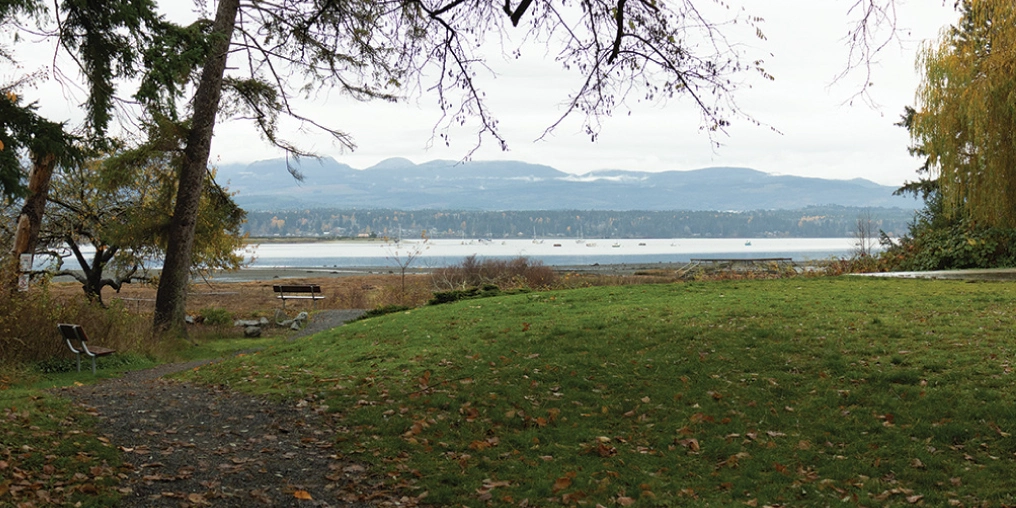
“This would have been the first thing paddlers saw as they rounded Goose Spit (Little Mexico),” he explains. It would have been about five to eight metres tall and would likely have had a painted front. It overlooked the fish traps and shell beds that provided abundant food for the Pentlatch.
“We know that this is a resting place for hundreds of our Ancestors, and we retain our deep connections and responsibilities to care for them and for this place.”
— Chief Nicole Rempel
“They had a rich body of resources,” says Morin. “They would’ve gotten about 90 per cent of their food—and certainly 99 per cent of their protein—from the ocean.” He adds that the Pentlatch had developed coastal marine resource harvesting tools, such as nets, spears, fish traps, and canoes, by as early as four to five thousand years ago.
“This site has been known since 1886 by archaeologists—and since forever by KFN elders,” says Morin. Chief Rempel confirms, “We know that this is a resting place for hundreds of our Ancestors, and we retain our deep connections and responsibilities to care for them and for this place.”
Mack Laing and the parks
And yet, today it’s better known as the home of the settler naturalist Mack Laing, who arrived here in 1922 and scooped up a few prime acres in the heart of the former Pentlatch village.
Two parks are named in Laing’s honour: The first is Baybrook, where the outline of his foundation is paved into that high-ranking family’s house mound. The second is Mack Laing Nature Park, where he lived from 1949 until his death in 1982. He deeded that site in 1973 to the Town of Comox with the proviso that it be maintained after his death as “a public nature park for recreation and conservation.”
Laing was aware that he was building on an Indigenous village; he wrote about it in his journals, and he collected and donated many artifacts from the site to the Courtenay Museum. In so doing, he was in contravention of a law passed in 1865 to prevent the violation of Indigenous burial grounds. Laing even wrote in his journal about finding burials in the area where he made his garden.
In his role supporting KFN’s protection of their heritage, Morin has found and reburied human remains near the creek. (KFN has cultural protocols for the treatment of their Ancestors’ remains. If you encounter Ancestral Remains, you should not move them, but contact KFN at archpermits@komoks.ca.)
Who are the Pentlatch
The Pentlatch are a Northern Coast Salish people whose language and culture have intermingled over hundreds or thousands of years with that of the K’ómoks people and Kwakwaka’wakw groups to the north. Like many Coast Salish people, the Pentlatch were catastrophically decimated by the smallpox epidemic in the late 18th century. Along with the K’ómoks and Eiksan, the remaining Pentlatch people amalgamated into the Comox Indian Band in 1876. Today, some members of the K’ómoks First Nation identify as Pentlatch descendants; and all KFN members now identify as caretakers of this territory; they feel a personal and spiritual connection to their Ancestors, and a responsibility to honour this relationship.
Katherine Capes, one of Canada’s first female archaeologists, excavated in the area in the 1970s and wrote about Pentlatch prehistory. She removed many artifacts from the area that continue to yield information as technology improves.
Morin says, “We only know so much about Pentlatch history. The only way to learn more is through places like this—looking at ancestral remains, archeological features, food remains, tools, etc. . . . .” Rather than further disturbing the site, any future research is likely to use this existing material, which could include anything from salmon bones to artifacts.
“We have a massive cultural site here that isn’t acknowledged in any way. Culturally and historically, this is a really important place; these lands were occupied by thousands of our Pentlatch Ancestors for thousands of years.”
What will happen with the site?
Mack Laing wanted the site to become a natural history museum; a long court battle over his wishes resulted in a court order for the Town of Comox to install public interpretation signage at the site. (Morin points out that Laing unwittingly did the site a favour when he left it to the Town, because if he hadn’t, the entire area would most likely be private homes by now.)
The signage, which will educate visitors about both Mack Laing’s and KFN’s histories, is currently in development. “While there is not yet public acknowledgement or recognition of our history and connection to this place, the Town of Comox is working with the Nation to develop interpretation that acknowledges our deep history here,” says Chief Rempel.
“We have a massive cultural site here that isn’t acknowledged in any way. Culturally and historically, this is a really important place; these lands were occupied by thousands of our Pentlatch Ancestors for thousands of years. By acknowledging and celebrating this, we’re not taking away from colonial history. We’re just honouring the truth of this place.”